I have often said that coordination and communication among the various groups that oppose the Great Jihad are our most important tasks. It’s time to put aside the factional infighting, the anathematizing of opponents, and the insistence on doctrinal purity. After our victory there will be plenty of time to decide whose method was the best, and who was the most ideologically correct.
Christine’s analysis is billiant:
Virtually everything we do is in coalitions, and that emergence of effective coalitions — often ad hoc, for single rallies, or over months over a piece of legislation, or locally as activists find each other from groups with common interests — is an important trend from the last year. A lot of our work is in helping to incubate those coalitions, both by supporting other groups, and also by helping to incubate single-issue sites that can become battlegrounds in this war of ideas.- - - - - - - - -
If you think of this in terms of war gaming, we need more pieces on the board. Our Islamist adversaries have a lot of pieces on the chess board, pieces they have been building with petrodollars for over a generation — new Islamic organizations like NAIT and ISNA (Wahhabi forces), pseudo-Western organizations to enforce the separation of Muslims from mainstream integration, such as CAIR, MAS, and MSA (Muslim Brotherhood forces), groups to effect infiltration and intimidation into existing Western NGOs and government agencies of Muslim Brotherhood supporters (FBI, U.S. Peace Institute, CIA, White House, Transportation Security Agency, Department. of Justice) .
A lot of Islamist dawa is about putting hundreds of organizations and individuals in place in each country’s civil and governmental institutions — not just in the USA. The strategy is one of colonization under Islamic Imperialism — for these Islamist groups to act as Muslim Brotherhood front groups, creating the parallel society of Shariah which will then be in place to take over as national sovereignty is corrupted and preoccupied with the chaos of civil war and terrorism. Gramsci, Qutb, Mao — various theorists of insurrection and colonization of the West have written on this. Our side is beginning to look at this now too, especially over the last half decade.
So much of what needs to be done right now is building up our own organizational capacity, finding people who can work together, and targeting key areas of weakness in our adversaries. Many groups are starting to do this.
I’ve worked with Muslims professionally over the years in various IT projects. Many train expertly as engineers, systems analysts and systems modelers. I wish I could see — because it exists somewhere — the system dynamics model that has been built, perhaps even by people I once knew, to model the Islamization of the West. It’s implicit, but given the skills and that Islamic cultural interest in the design of complex, internally referential systems, I suspect several models are out there competing for strategic dominance as the most useful tool. Our adversaries are wargaming our terms of surrender; it is up to us to build the wargames to define our terms of victory.
This is where our political leaders have failed so miserably, in failing to understand dawa, jihad, supranational terrorism, state-sponsored terrorism, the whole set of tactics as a single system. It doesn’t need a single political entity governing it, to function systematically. You can build these things fairly loosely and they still keep functioning.
Building such analytical models of global Islamization ourselves- not in STELLA or powersim necessarily, but in something more generally accessible, like Excel — is not a bad activity, as a kind of Red Team wargaming activity. Making it public is good, to show the connections between Islamist attack vectors. There are other ways to provide this holistic view of the problem — novels, plays. A culture of resistance requires a breadth of approaches.
But we must fight on the entire game board — against all these attempts to Islamize the west — not just one tiny corner of the board called terrorism, as our political leaders are now doing. To fight against al Qaeda and to legitimize CAIR is like playing chess and saying you like the other guy’s bishops and rooks, and wouldn’t want to offend him by capturing them, so you’re going to play “fair” and only capture his knights.
So we do need to model what our adversaries are doing, and that is Red team wargaming. And then we can build — less publicly perhaps — a model for Blue Team response. We’re doing that now ad hoc, by resisting Islamization with many groups. But we know enough now to plan.
And we need to communicate our findings, both to the general public and to political leaders (possibly through public pressure, since they are willfully blind). We need government leaders who understand wargaming, to stop legitimizing “self-appointed” leaders of Muslims who never chose those leaders.
Truman, Eisenhower and Reagan never met with the American Communist Party to show their “outreach” to the American Workers. It makes even less sense for government officials to meet with supporters of Hamas and Hezbollah, such as CAIR and the Arab American Anti-Discrimination Committee, and pretend that doing so means they are engaging in “outreach” to American Muslims. It is a betrayal of trust and a creation of moral hazard that exceeds Neville Chamberlain’s, for he gave away another country, and they are giving away their own.


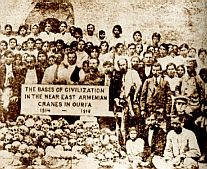 For the last ninety-two years, the Turkish authorities have been denying that the events that occurred in Anatolia in 1915 constitute a genocide against the Armenians.
 There’s been
 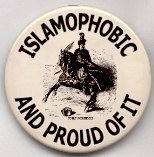 That’s why it’s important to accept and celebrate our Islamophobia. We’re Islamophobic and proud of it!
 How much faith do you have in the political appointees and federal civil service apparatchiks charged with protecting you from terrorist attack?
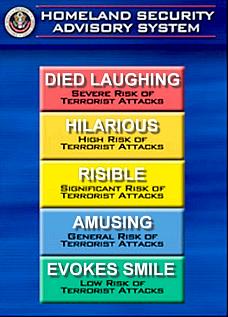 I subscribe to a Department of Homeland Security mailing list called the DHS Daily Open Source Infrastructure Report, which is basically a collection of excerpts and hyperlinks to news stories about security issues in communications, transportation, finance, and other critical sectors. The highlighted stories are frequently about cyber-security — e-mail scams, viruses, stolen laptops, etc.