 Note:
Note: This post is of necessity long and involved, because the Organization of Islamic Cooperation does
not pursue its goals in a straightforward fashion. If the OIC made all its moves in broad daylight where everyone could see what was happening, this article would not only be much shorter, it would be unnecessary.
Unraveling the knots of the OIC’s intentions requires lengthy exposition, much explaining, and laborious interpretation. The reader may be halfway or two-thirds of the way through this post before he realizes what I’m trying to do.
Bear with me: this really is going somewhere. The result will be worth your time.

In the aftermath of the Oslo massacre, the common theme in the mainstream media on both sides of the Atlantic was that “anti-Islam” websites like this one were at least partially responsible for the slaughter carried out by Anders Behring Breivik. According to the media’s logic, we “created a climate of hate” that helped legitimize the actions of the killer.
As our
several of our
recent posts have demonstrated, however, the opposite was in fact the case — any opposition to Islam in the West has been relentlessly
delegitimized and demonized in public discourse for at least the last decade. The absolute ban on any meaningful discussion of the issues at stake prevented any normal political action, leaving the field open for a psychopathic mass-murderer to do it his way. Many ordinary people have long been silenced, since opposing Islam is often a career-killer, but why would a psychopath worry about such trivial matters?
The public standards regulating the discussion of Islam all across the West are remarkably uniform. Whether enforced formally or informally, they require the suppression of free speech in draconian ways that are not applied to speech about any other religion or group. How did this come about?
All of these rules about what may and may not be said about Islam — where did they come from?
Longtime readers already know the answer to that question: the discussion of Islam in the public forums of the West is regulated by the tenets of shariah, as described in the Koran and the Sunna of the Prophet and codified in the four principal schools of Islamic law. This application of shariah in the West accords with the
repeated demands of the Organization of Islamic Cooperation (OIC) as promulgated through resolutions at the United Nations. The behavior of the media, the academy, and Western political leaders closely follows the strictures against the “defamation of religions” as laid down by the OIC.
The
first post in this series examined the American influences on Anders Behring Breivik.
Part Two looked at the killer’s training and connections in Belarus, Russia, and Chechnya.
In this third installment we’ll highlight a different sort of influence:
- What created the environment in which a Norwegian mass murderer could be “weaponized” so effectively against the European Counterjihad?
- Why are our governments and our media complying with the demands of the OIC?
- How did Western Europe and the United States become such willing and diligent enforcers of shariah law?
* * * * * * * * * * * * * * *
To understand the astonishing degree to which the Organization of Islamic Cooperation has subverted the institutions of the West, it is necessary to investigate in some detail the historical and legal basis for the OIC’s demands.
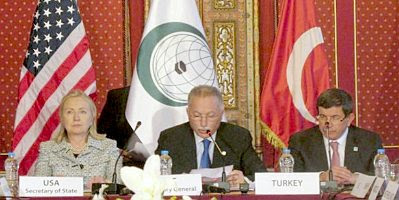
Back during the Danish Mohammed cartoon crisis in 2006, Professor Ekmeleddin Ihsanoglu, the Secretary General of the OIC,
said this [pdf]:
The angry reaction in the Muslim world… is mainly due to the premeditated and deliberate attack on the revered person of the prophet, whose holy position, message and teachings were maliciously and calculatingly sacrilege by the so called defenders of freedom.
To Prof. Ihsanoglu, the rights and freedoms we enjoy in the West are illegitimate and deserving of scorn. He and the OIC recognize a different standard, one that sets well-defined limits on freedom of speech as required by Islam. As I
pointed out last week, the OIC foreign ministers recently
passed a resolution [pdf] that included these clauses (italics added):
| 7. | | Expresses its deep concern over the frequent and erroneous association of Islam with violations of human rights and the misuse of the print and audio-visual media in propagating such misconceptions which lead to the reinforcement of prejudice and discrimination against Muslims and calls on the Member States to undertake information activities to counter these activities; |
| 8. | | Notes with grave concern the increasing trend of Islamophobic measures in the Western countries, stresses the responsibility of those States to ensure full respect to Islam and all divine religions and the inapplicability of using freedom of expression or press as a pretext to defame religions, and calls for refrain from imposing restrictions, in any form whatsoever, on the cultural and religious rights and freedoms of people. |
| | | […] |
| 10. | | Expresses the need to pursue, as a matter of priority, a common policy aimed at preventing defamation of Islam perpetrated under the pretext and justification of the freedom of expression in particular through media and Internet. |
As is often the case with Islam, common English phrases such as “human rights” and “defamation of religion” mean something different to the Muslims of the OIC than they do to non-Muslims.
The founding document of the Organization of the Islamic Conference (now the Organization of Islamic Cooperation) is its
Charter [pdf], which states in Article 15:
The Independent Permanent Commission on Human Rights shall promote the civil, political, social and economic rights enshrined in the organisation’s covenants and declarations and in universally agreed human rights instruments, in conformity with Islamic values. [emphasis added]
So what “universally agreed human rights instruments” are referenced here? Is the OIC referring the
Universal Declaration of Human Rights, which was passed by the United Nations soon after its founding?
Not at all. The OIC considers the UDHR inadequate and un-Islamic. To codify the human rights of Muslims, the OIC created the
Cairo Declaration on Human Rights in Islam, commonly known as the “Cairo Declaration”. It is a formal legal instrument put together by the OIC on behalf of OIC member states in 1990, and was formally served to the United Nations in 1993.
Article 22 of the Cairo Declaration states:


 Reports of the capture of Saif Al-Islam Qaddafi were apparently premature, since the son of beleaguered Libyan dictator Muamar Ghedafi appeared with an armed entourage at a hotel in Tripoli, where he was taped and photographed.
