Gates of Vienna has recently acquired a new reader. Ali Eteraz, who came to this country from Pakistan, has been commenting here during the past week. Having visited his blog,
Unwilling Self-Negation, I recommend him to our readers.
There is a link to one of his essays,
Because Allah Wills It, which was published in
Killing the Buddha (“a religion magazine for people made anxious by churches”) in 2003.
Mr. Eteraz’description of his experiences as a child in Pakistan within the traditional fatalism of Islam is powerful:
Dera Ghazi Khan, Pakistan, is one of those continually endangered communities where outrageous fortune visits often in the form of drought, disease, and heat. Life is unchanging and tedious… Parents worry that their youth will join the new “Islamic Organizations” — which, in Dera Ghazi Khan, are words that refer to any group of divinely sanctioned extortionists intimidating the shop owners.
This is one of those cities where the harshness of life has made the exterior of its citizens tough enough to withstand the heat of the desert. The spirits of its people, on the other hand, are not as taut and unbending as their bodies suggest…
The type of man borne from the sermons in Dera Ghazi Khan welcomes sorrow, relishes pain, and exalts suffering. For him there is no value in the success of his relationships unless they add to one's misery; there is no value in tears because they would mitigate the sorrows — and that is not wanted. The irony is that even if one comes to realize the unhealthiness of such a way of life, the impractibility of always being life’s martyr, one dares not let go of it, because being happy now, in this life, means being damned tomorrow. After a life in Dera Ghazi Khan, no one wants an even worse afterlife.
[…]
By 1993, the militant Islam that had helped to drive out the Soviets from Afghanistan had been imported to Dera Ghazi Khan. It acquired its legitimacy by a backwards reading of Islamic texts; and it supported the imposition of Islamically sanctioned public stonings, floggings, amputations, and crucifixions. Such Islam was made to pander to cruelty. Consider the paradox: the same Islam which in passage after passage of the Koran promises its believers green gardens in exchange for their moral lives now promised them satisfaction by sanctifying cruelty upon other men.
The intervention of the Pakistani government has prevented the spread of such punishment-based religiosity. The impulse, however, remains unsatisfied. Thus, it occurs that the desire to see cruelty in action simmers into the general populace and creates two sub-cultures. First, there are the sort of people like my cousin Tazir. To him, to be Muslim is to be nothing more than to be someone who must support the expansion of the flags of Islam throughout the entire world. He has no conception of the consequences. Second, there are people like my aunt Bushara. Her husband took on a second wife without her consultation and then moved said second wife into the same house as her. Instead of rising in resistance, she simply went to pray.
Unfortunately for Mr. Eteraz, coming to America did not guarantee that he would leave all this doleful religious baggage behind in Pakistan.
So I became fatalistic and apathetic like Aunt Bushara. I remained within the folds of Islam because it gave me a framework in which to be submissive; and in being submissive, remain static. It let me believe that my inertness was tolerable, if not altogether ideal.
I always chuckle when I hear the political pundits calling people like me, us placid pools of personality, the “saving force” of Islam simply because we are not firebrands like Bin Laden. I’m also amused when I see some of those who share my faith, from places not unlike Dera Ghazi Khan, strutting around and considering themselves the highest of Muslims in the world simply because they are removed from the difficulties of “the old country” even though they live a life of silence.
Many pundits, both inside and outside the community of immigrant American Islam, have rested their hopes upon us muted ones. They expect us to free global Islam from the Tazirs and Bin Ladens of the religion. Somehow we cows, chewing on the cud of our paranoia-stricken life, have been labeled “moderate” as if we offer a counterweight to the extremists. We don’t.
So don’t expect any optimistic outlook from this particular Muslim. He does not hold out much hope for his side of Islam as a force of change.
* * * * * * * * * * * * * * *In the comments section on my
Flight 93 post, Mr. Eteraz and I got into a discussion about “moderate Muslims” and the appropriate terminology for them. One of his comments is worth reproducing in full:
hi baron,
thanks for the acknowledgment. as far as classifications go, you should call all ‘moderates’ simply “Muslim” and when you come across the violent/nut-job Muslims, call them Islamists or Wahhabi. But if you do this, this way of speaking would have to spread to everyone who wants to see changes in Islam and holds out hope for the ‘moderate’ element winning.
Here’s why. Right now ‘moderates’ like me have to spend *way* too much time defending Islam from those people who want to put all Muslims in one box. As a consequence of this, we have very little time left to actually go and confront the Islamists and Wahhabis. I engage in a lot of debunking of Wahhabis and Islamists, mostly because I have consciously chosen to forego making non-Muslims aware of all these distinctions. Most moderates, though, are not that brave (or thick-skinned). Yeah you can say they are a little timid. In other words, they are like those insecure girls you had in high school who would only do something unless you were totally on their side.
Also, the BIGGEST reason that Wahhabis and Islamists get so much clout is because non-Muslims don’t distinguish Wahhabis and Islamists from “normal” Islam. In other words, critics of violent Muslims simply call the perpetrator “Muslim” while reserving the more specific “moderate Muslim” for the peaceful Muslims. It needs to be the other way around. It is the Wahhabis who need to be called “extremist Muslims” or “violent Muslims” and the moderate Muslims who need to be called “Muslim.” Language is powerful and it is not on the side of the ‘moderates.’
See, when you call us “progressives” or “reformists” you undermine our authority against the Wahhabis who consider themselves “traditionalists.” At this point in time, the fight within Islam isn’t about who is the most forward looking. It is about who best reflects Muhammad’s name. In other words, its a fight about who controls history. For ‘moderates’ to win, we need to be able to demonstrate that we are the better and correct representatives of the era of Muhammad’s life.
Fair enough, Mr. Eteraz. But I still need a separate term for the “moderate.” After all, the extremists consider themselves simply “Muslims” and use the word to describe themselves. To avoid confusion, we need another word or phrase. Any suggestions?
After all, the Mormon religion is based in Christianity and Mormons worship Jesus Christ. But their religion differs significantly from Christianity, so we call them “Mormons” to distinguish them (and it’s shorter than “members of The Church of Jesus Christ of Latter-day Saints”).
We already have a term for the Islamists, for the violent extremists. The Wahhabis and their South Asian cousins, the Deobandis, are known collectively as “Salafists”.
What’s the opposite of “Salafist”?
I can list the characteristics of the hypothetical anti-Salafists:
| 1. | They acknowledge freedom of religion, including the right to practice any religion, to convert to or from any religion, or to practice no religion at all and live as an atheist. They insist that no one has the right to coerce anybody into any religious practice, or prevent them from practicing their faith. |
| 2. | They acknowledge freedom of speech, including the right to insult, ridicule, denigrate, and demean the religion of others. They insist that no one has the right to coerce silence or “correct” speech from anyone. |
| 3. | They acknowledge that women have full rights, equal to those of men, and that those rights include the freedom to marry or not marry anyone they like, to be subject to a dress code no more restrictive than that applied to men, and to have a full and equal rights in a court of law. |
| 4. | They acknowledge the existence of the rule of law. This means that they accept that the acquisition of political power, through democratic means or otherwise, does not confer impunity upon political leaders; that those leaders are subject to the same laws as everyone else. |
| 5. | They acknowledge that the above conditions may not be violently abridged by groups working inside or outside of state control; that those who do act violently will be punished to the full extent of the law. |
These are the basic rules common to what is known as Western Civilization. If some “moderate” subset of Islam, as yet unnamed, were to publicly embrace them and incorporate them in its political structure, than that group would join the West and leave the East to the Islamists, the Chinese, and Kim Jong-Il.
I doubt that you or anyone else expects something like this to happen anytime soon. These principles contradict what is written in the Koran and what has been practiced by the vast majority of Muslims since Mohammed entered Mecca. A Muslim who embraced these principles would find himself forsaking his own religion.
But I won’t rule it out. Christianity and Judaism went against some of their own religious scriptures when they produced secular modernity, so anything is possible.
And here’s where I take issue with you. You say:
Right now ‘moderates’ like me have to spend *way* too much time defending Islam from those people who want to put all Muslims in one box. As a consequence of this, we have very little time left to actually go and confront the Islamists and Wahhabis… Also, the BIGGEST reason that Wahhabis and Islamists get so much clout is because non-Muslims don’t distinguish Wahhabis and Islamists from “normal” Islam.The behavior of non-Muslims does
not cause Muslims to do whatever it is they do, or give any particularly group of Muslims more or less power.
The West has historically had no more knowledge or understanding of Hindus than it has had of Muslims. Yet that did not turn some subset of Hindus into radical bomb-throwers, nor empower any one Hindu group at the expense of any others.
One of the chronic conditions of Islam, moderate or otherwise, is to blame non-Muslims for the problems afflicting Islam. It’s like the alcoholic who blames his wife’s behavior for his drunken binges.
It’s time for Islam to live with the hangover and sober up. And, perhaps, go to an AA meeting and start on the first of the Twelve Steps.
 UPDATE:
 Mr. Eteraz has responded in the comments, and points out that his essay in
Killing the Buddha was primarily literary, and that the conclusions about his own fatalism here in America were meant ironically.
He says, “In short, your statement, ‘He does not hold out much hope for his side of Islam as a force of change.’ is patently *wrong.* I am *precisely* the kind of creative and subtle thinker that gives Islam its hope. We who are conversant (and in my case, in love with) Nietzsche; and Rousseau; and Montesquieu; and Aquinas; and irony; and the surrealists. The fact that sometimes I choose to make my points in satirical ways should be a sign of intellectual maturity; not hopelessness. I encourage you to revise your views.”
And so I have. Mr. Eteraz is a subtle writer, and I am re-reading his essay with that in mind. I urge other readers to do the same.

 So this Palestinian walks into a bar and sits down.

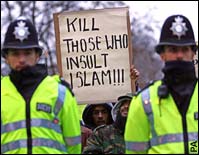
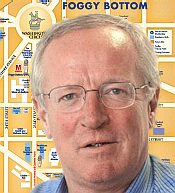 According to
  These imams calling for holy war, for a worldwide day of anger, are trivial, trifling people. They are deliberately stirring the cinders in order to get a conflagration going. They are like those nut-job arsonists who set fires in forests just to see the raging flames destroy everything. And don’t forget, arsonists are seriously disturbed people. Ask any psychiatrist.
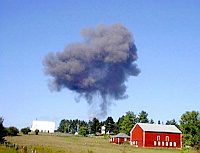 On Monday night I watched the made-for-TV movie
  If it weren't for the Brussels Journal, Europe would not be now growing a spine. Or at least some of the continent appears to be walking upright. In Germany, for instance, Die Welt and Berliner Zeitung finally showed some solidarity with Denmark's principled stand on freedom of the press by printing the twelve Mohammed cartoons.
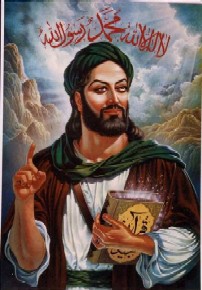 The second is the
 But the bosses had already seen the winds change and four months ago began developing a non-alcoholic beer to be ready for the summer. For good measure they gave the bottle a green label, the colour of Hamas.