European Free Speech Under Attack
Defending the right to say that Islam is primarily a totalitarian ideology aiming for world domination.
By Geert Wilders
“The lights are going out all over Europe,” British Foreign Secretary Edward Grey famously remarked on the eve of World War I. I am reminded of those words whenever I read about Europeans being dragged into court for so-called hate-speech crimes.
Recently, Danish journalist Lars Hedegaard, president of the International Free Press Society, had to stand trial in Copenhagen because he had criticized Islam. Mr. Hedegaard was acquitted, but only on the technicality that he had not known that his words, expressed in a private conversation, were being taped. Last week in Vienna, Elisabeth Sabaditsch-Wolff, an Austrian human-rights activist, was fined €480 for calling the Islamic prophet Muhammad a pedophile because he had consummated his marriage to a nine-year old girl. Meanwhile, my own trial in Amsterdam is dragging on, consuming valuable time that I would rather spend in parliament representing my million-and-a-half voters.
How can all this be possible in supposedly liberal Europe? The Dutch penal code states that anyone who either “publicly, verbally or in writing or image, deliberately expresses himself in any way that incites hatred against a group or people” or “in any way that insults a group of people because of their race, their religion or belief, their hetero- or homosexual inclination or their physical, psychological or mental handicap, will be punished.”
Early in 2008, a number of leftist and Islamic organizations took me to court, claiming that by expressing my views on Islam I had deliberately “insulted” and “incited hatred” against Muslims. I argued then, as I will again in my forthcoming book, that Islam is primarily a totalitarian ideology aiming for world domination.
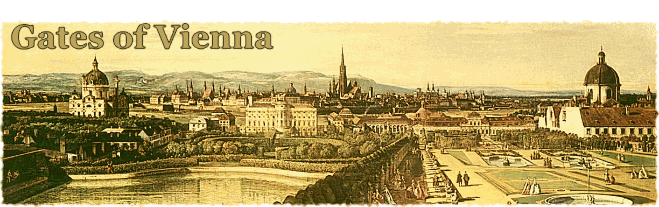
At the siege of Vienna in 1683 Islam seemed poised to overrun Christian Europe.
We are in a new phase of a very old war.
Monday, February 21, 2011
Open Season on Europeans Who Insult Islam
In an op-ed for tomorrow’s Wall Street Journal, Geert Wilders talks about the ongoing suppression of free speech in Europe:


The Fine Art of Waffling
Momentous events are underway in the Middle East. The situation is changing so rapidly that there is no time to catch one’s breath between batches of gruesome and astonishing news dispatches.
 The most rapid changes are occurring in Libya. The protests there got off to a late start compared with the rest of the Maghreb, but the Libyan insurrection raced ahead of the pack very quickly. Thousands of demonstrators took to streets and have been mercilessly attacked by police and military units. Protesters have reportedly been machine-gunned and strafed by aircraft, and at least several hundred are dead.
Despite the brutal crackdown by the authorities, the rebels have seized control of several cities, including Benghazi. They are also gaining strength in the capital, Tripoli, and have burned the parliament building. An undetermined number of army units have defected to protesters, and a number of Libyan diplomats abroad have resigned in solidarity with the dissidents. Several military aircraft were flown to Malta to keep them from being used by the regime.
Four major tribes are said to have gone over to the rebellion, and they are threatening to cut off the oil supply lines. BP has closed down its operations in Libya for the time being, and the country’s economy is in free fall. Stock markets in southern Europe in which Libyan holdings are prominent have taken the biggest hit, but all European markets are down.
Col. Moammar Ghadafi and his sons are expressing absolute defiance towards the protesters, and have promised rivers of blood and a full-scale civil war if the insurrectionists don’t back down. As of the time of writing, a Saharan Ragnarok seems all but unavoidable.
We are at one of the hinges of history, so what is the Obama administration doing?
Well, it’s doing what it does best: “expressing concern”, “calling for restraint on both sides”, “urging the Libyan government not to react with violence”, etc. If none of these stern measures has the desired effect, then it will “continue to monitor the situation closely”.
A choice example of Obama-style foreign policy was reported by AGI News:
The most rapid changes are occurring in Libya. The protests there got off to a late start compared with the rest of the Maghreb, but the Libyan insurrection raced ahead of the pack very quickly. Thousands of demonstrators took to streets and have been mercilessly attacked by police and military units. Protesters have reportedly been machine-gunned and strafed by aircraft, and at least several hundred are dead.Despite the brutal crackdown by the authorities, the rebels have seized control of several cities, including Benghazi. They are also gaining strength in the capital, Tripoli, and have burned the parliament building. An undetermined number of army units have defected to protesters, and a number of Libyan diplomats abroad have resigned in solidarity with the dissidents. Several military aircraft were flown to Malta to keep them from being used by the regime.
Four major tribes are said to have gone over to the rebellion, and they are threatening to cut off the oil supply lines. BP has closed down its operations in Libya for the time being, and the country’s economy is in free fall. Stock markets in southern Europe in which Libyan holdings are prominent have taken the biggest hit, but all European markets are down.
Col. Moammar Ghadafi and his sons are expressing absolute defiance towards the protesters, and have promised rivers of blood and a full-scale civil war if the insurrectionists don’t back down. As of the time of writing, a Saharan Ragnarok seems all but unavoidable.
We are at one of the hinges of history, so what is the Obama administration doing?
Well, it’s doing what it does best: “expressing concern”, “calling for restraint on both sides”, “urging the Libyan government not to react with violence”, etc. If none of these stern measures has the desired effect, then it will “continue to monitor the situation closely”.
A choice example of Obama-style foreign policy was reported by AGI News:
The Wages of Sin and the Karma Dude

2011 Winter Quarterly Fundraiser, Day Six
[edited]
The Baron mentioned what a wonderful time we had at an afternoon birthday party the other day. It was great fun, except for one tiny glitch: I went soaring off my strict low-carb diet, flying through fields of forbidden foods, including large helpings of homemade coffee ice cream.
 Meanwhile, the sainted Baron, who has been following the fibromyalgia diet with me in order to help me maintain the rules, limited himself to two bites of that ice cream. Otherwise, he made do with a bowl of our host’s famous chili and a salad. I, on the other hand, had some chili and salad before moving on to sample every forbidden crostini, cracker, chip, and dessert available. Starch and sugar were my middle name.
The result was a carbohydrate hangover of biblical proportions. I suddenly recalled why I’d stopped eating sugar and starches: because when I fall into a dish of crostini — to heck with the dip — the next day’s result is painful remorse. None of the symptoms of alcohol indulgence, just unremitting pain and fatigue in every stressed cell in my body. So, except for a few brief excursions to the computer to write thank you notes, most of my post-party day was spent horizontally, surrounded by pillows to cushion the pain. This horizontal perspective certainly allows for a better view of the wages of sin. In my case, the sins had consisted of cavorting through fields of desserts and other damning dishes of starchy goodness. I had plenty of time to recall Charlie Brown’s plaintive remorse: “the wages of sin are ‘Arrgh!’” Indeed they are, Charlie: angst and arrgh.
 Even though pain has a certain eternal feel to it, nothing lasts forever. The wounds of that self-inflicted assault on my metabolism are fading; by mid-week they will be a memory as I move back into regular, predictable pain. So I learned once again that if I want to live a less restricted life, I’d better eat a more restricted diet. Right now the trade-off seems quite rational. Give me three months, put a plate of tiramisu in front of me and I will be deaf to rationality. At the moment, however, be assured I’m all ears.
Before falling into sin I’d been making great progress on our project of simplifying — i.e., cutting down, cutting out, and making do. It’s a good thing we have the example of a former generation to follow but it still takes time to translate their lessons into a modern lexicon. Sure, you can do the easy stuff like eating on the lower end of the food chain. That decision is obvious. But the others are harder.
 We’ve never been shoppers, if you don’t count books (and I can count on one hand the number we’ve bought since our financial picture changed). I had fun buying “office couture” for the Baron, but he doesn’t wear those clothes anymore. Not unless he has to go to Washington for conferences and pass for normal. The wardrobe he has now will last a long time, especially if I can talk him out of putting his wallet in the back pocket of his good trousers. That pocket is a bit threadbare — only works if he’s wearing a jacket to hide it.
Most of our other needs can be handled via thrift shops or simply doing without — e.g., the Baron broke his one remaining tie clasp on the safety belt of our car. Since he uses the clasp once a week for the tie he wears to church, a trip to the consignment shop resulted in a serviceable two dollar replacement. Not surprisingly, second hand shops are cropping up like weeds after rain…
Speaking of safety belts on cars, one obvious simplification was to sell one of our two cars.
Fjordman: Metal and Early European Warfare
Fjordman’s latest essay has been published at Vlad Tepes. Some excerpts are below:
Late Bronze Age Europe was apparently a turbulent place where weaponry evolved fast. “The sword, for instance, which had been developed in the east Alpine area in the Middle Bronze Age, assumed a variety of forms whose rather rapid pace of change probably reflects the need constantly to update equipment if military success is to be maintained. It was at once a functional implement (as shown by the degree of wear and resharpening on some pieces) and an object important for display purposes.” Moreover, “Armour (shield, helmet, cuirass, greaves) played an increasing role in the mechanisms of Bronze Age warfare, but archaeologically it is those pieces that were made in metal that survive, and these were not the ones that were functionally most effective. It has been shown experimentally, for instance, that shields of sheet bronze can be cut by a slashing blow from a sword, whereas those of leather or wood are much tougher. Added to the difficulty of moving freely in sheet-metal armour, it is much more likely that leather was the normal material and that these metal pieces were for display — either in warlike ceremonies, or intended to strike fear into the hearts of opponents at the mere sight, much as happened with Homer’s heroes in the Iliad.”
“A Child Must Be Protected”
On February 19, 2011, Rene Stadtkewitz’ party Die Freiheit held its first meeting in Hannover, Lower Saxony. About 130 people from all walks of life gathered in the Hannover Congress Center to express their interest in the new party and to listen to speeches by the party leader, the local party leader, and Elisabeth Sabaditsch-Wolff.
This was the first time Elisabeth had spoken publicly since her conviction last Tuesday for “denigrating the religious teaching of a legally recognized religious group”.
Many thanks to Kitman for YouTubing this video:
This was the first time Elisabeth had spoken publicly since her conviction last Tuesday for “denigrating the religious teaching of a legally recognized religious group”.
Many thanks to Kitman for YouTubing this video:
Sunday, February 20, 2011
Gates of Vienna News Feed 2/20/2011
 The big story of the day comes once again from North Africa, this time from Libya. The uprising against the Ghadafi regime has escalated very quickly, and the government retaliated ruthlessly, reportedly using machine guns and RPGs against the demonstrators. Benghazi is the center of the uprising, and is said to be all but in the hands of the insurgency. Col. Qaddafi and his sons vow to fight on to the last man (and last woman) standing. Some army units and at least one major tribe have joined the revolt. Two Libyan ambassadors in Asia have resigned in protest of the government’s brutal response to the protests. Hundreds of people have been killed.
On a related note, Chinese dissidents attempted to mount a “Jasmine Revolution” modeled on the Egyptian and Tunisian uprisings through social media. Their efforts have so far been suppressed by the government.
In other news, according to reports from South Korea, the North is preparing to test another nuclear device.
To see the headlines and the articles, open the full news post.
Thanks to C. Cantoni, DF, Fjordman, Insubria, Larwyn, Mary Abdelmassih, Steen, TV, and all the other tipsters who sent these in.
Commenters are advised to leave their comments at this post (rather than with the news articles) so that they are more easily accessible.
Caveat: Articles in the news feed are posted “as is”. Gates of Vienna cannot vouch for the authenticity or accuracy of the contents of any individual item posted here. We check each entry to make sure it is relatively interesting, not patently offensive, and at least superficially plausible. The link to the original is included with each item’s title. Further research and verification are left to the reader.
The Iranian Navy at the Gateway to the Med
The Egyptian government has now granted them clearance, and two Iranian warships are scheduled to enter the Suez Canal tomorrow. Destination: Syria.
Many thanks to Vlad Tepes for YouTubing this report from RT:
Many thanks to Vlad Tepes for YouTubing this report from RT:
Blaspheming Against the Blasphemy Law
I recently alluded to Alice’s Adventures in Wonderland in an attempt to describe the dreamlike insanity of the “hate speech” conviction against the Austrian anti-jihad activist Elisabeth Sabaditsch-Wolff.
Other literary examples of institutional madness are also appropriate when Islam is the topic of the day. A frequent candidate is Catch-22 by Joseph Heller, which is what came to mind when I read this article from Agenzia Fides about the deadly absurdities of Pakistan’s blasphemy law:
Fortunately for Ms. Rehman, the court decided that there was no basis for the case against her, and dropped the charges. She’s not out of the woods yet, however, because the fundamentalists consider her a blasphemer, and she is still living under a death threat.
What’s notable in this story is the fact that questioning the blasphemy law is itself blasphemy. And the punishment under sharia for blasphemy is, of course, death — making this legal confection a perfect closed system.
Here’s another closed system to which the Pakistani legal system bears more than a passing resemblance:
Other literary examples of institutional madness are also appropriate when Islam is the topic of the day. A frequent candidate is Catch-22 by Joseph Heller, which is what came to mind when I read this article from Agenzia Fides about the deadly absurdities of Pakistan’s blasphemy law:
Sherry Rehman, Promoter for Amending the Blasphemy Law, Incriminated for Blasphemy
Lahore (Agenzia Fides) – Sherry Rehman, Parliamentarian from the Pakistan People’s Party, the woman who presented the motion to the Pakistani Parliament to modify the blasphemy law has been formally charged with blasphemy. The decision was taken by a court in Multan, which enlisted the local police to register the charge of blasphemy against Rehman. The court received the denouncement by a local shopkeeper, who accuses the woman of blasphemy in her address on television in November 2010. The local police, for now, have declared her legally incompetent. In recent weeks there have been other attempts to incriminate her but other Pakistani courts have refused to give authorisation.
This news creates “discouragement and deep concern within the Christian community” which, as a local source of Fides confirms, sees its fears being realised: that it has gone beyond the idea of defining “blasphemous”, and therefore, anyone who opposes the law on blasphemy can be incriminated.
Meanwhile cases are multiplying in which extremist Islamic groups openly praise the “holy war”, the civil disobedience and murders. Fides sources in Pakistan’s civil society express growing concern that these attitudes, however, “are not producing any solid responses from the Pakistani Government,” which “should stop these preachers of hate and lawlessness.” Many mullahs use the Friday sermon to convey hostile messages to increase social and interreligious tensions, to override the rule of law.
Fortunately for Ms. Rehman, the court decided that there was no basis for the case against her, and dropped the charges. She’s not out of the woods yet, however, because the fundamentalists consider her a blasphemer, and she is still living under a death threat.
What’s notable in this story is the fact that questioning the blasphemy law is itself blasphemy. And the punishment under sharia for blasphemy is, of course, death — making this legal confection a perfect closed system.
Here’s another closed system to which the Pakistani legal system bears more than a passing resemblance:
Of Gods and Men and Heroism of Faith

A French film entitled Of Gods and Men (Des hommes et des dieux), which won the Grand Prix at Cannes last year, has now been released with English subtitles. It is based on a true story of seven French monks kidnapped and massacred by Islamic bandits in Algiers in 1996.
Below is a review of the movie written for Gates of Vienna by the New York-based writer David Gurevich.

Of Gods and Men and Heroism of Faith
by David Gurevich
From pedophilia to corrupt Vatican banks, it has been a while since anyone in the media had a good word to say about the Catholic Church, one of biggest bêtes noirs of liberal media and artists. But in a new French movie by Xavier Beauvois called Of Gods and Men, such concerns are the last thing on the minds of eight monks quietly tilling their modest garden and treating villagers at the foot of Atlas Mountains in Algeria.
The monks are elderly and in poor health, but they happily persist in doing God’s work, and in between hoeing their garden and selling honey at the market and treating cases of eczema among local Arab children they never forget to praise the Lord. In fact, their choral singing, choreographed in a measured ascetic non-Hollywood way, makes for the most striking scenes. So how can such an unassuming group become a subject for such a richly dramatic and exceptionally timely film, based on the events that took place in Algeria in 1996?
Modernity invades abruptly. The anti-government Islamic Front issues an ultimatum: All foreigners must leave the country. At a nearby construction site, Croatian workers end up with their throats cut. The village elder’s granddaughter is stabbed for not wearing hijab. Finally, a local government official offers to post soldiers on the monastery territory (and is vehemently rejected) and then suggests that the monks should leave — “I can’t protect you.”
This is the real starting point when this deceptively simple routine of life of a religious community becomes a high drama of human heroism — and what inspires this heroism. Up until this scene, the Eight are rather nondescript old men in cassocks, save for their leader Christian (Lambert Wilson) and the elderly Dr. Luc (Michel Lonsdale).
As they debate whether they should leave or stay, they emerge as individuals, with their own human foibles and aspirations — one misses his family, his little grand-nephews and -nieces; yet he realizes that after so many years the monastery has become his real family, that serving God has glued them together as nothing else can, for it is the very meaning of the Faith and serving God that transcends human emotions. “I never meant to be a martyr,” says another. “But you already gave your life to God,” Christian argues.
And so they embark on this day-to-day struggle, trying to preserve faith in the face of everyday threats that come both from the Islamists who demand medical treatment and from the military who demand that the monks give up the rebels. And then there are the villagers who beg them to stay — “you are the branch, and we are the birds” — or, in other words, without you we’ll be done for. The monks cannot leave, and in a war like this the peaceful don’t survive.
A Place in the Shadows

2011 Winter Quarterly Fundraiser, Day Five
Dymphna and I spent a pleasant afternoon yesterday at the birthday party of an old friend who lives not far from us. Most of the guests were people of a certain age whom we have known for many years.
In normal circumstances, when we crawl out of our Counterjihad den into the full light of day, there is no overlap between our doings here at Gates of Vienna and the people we meet in the real world. The shameful secret of what we do here in the dark in front of our demonically glowing computer screens is not something we have to share.
But yesterday we were celebrating among friends, some of who are fellow conservatives who know exactly what Dymphna and I do when we’re at home. Nevertheless, most of the rest of the guests were liberals of varying degrees in their political views; revealing our Islamophobia would not have been conducive to a pleasant and festive atmosphere.
However… One of our good friends is a regular reader of Gates of Vienna who agrees with us on matters political, so discussing political topics (including the jihad) with her is all but irresistible. She and I ended up standing in the kitchen talking about Yusuf al-Qaradawi, the Muslim Brotherhood, and the political upheavals throughout the Middle East. Fortunately for us (and for the rest of the party), most people within earshot had no idea who Qaradawi was, so our discussion was able to remain in the virtual shadows.
And there are always so many other things to talk about — mutual friends, children, grandchildren, gardening, food, wine, the local historical society, etc. We veered off into other topics, and the afternoon remained unmarred by political contention, much to Dymphna’s (and our hosts’) relief.
My job has trained me keep my head down and my opinions mute when socializing with people I don’t know very well. The big exceptions, however, are those delightful occasions when I attend anti-jihad events both here and abroad. That’s when I can let what’s left of my hair down and discuss the Great Jihad just as I do in this space.
Saturday, February 19, 2011
Gates of Vienna News Feed 2/19/2011
The unrest in the Middle East has spread to the tiny nation of Djibouti on the western shore of the Red Sea, where street protesters are demanding the ouster of the current regime. Violence continues in Bahrain, where an undetermined number of protesters have been shot and killed by police, who were forced to pull back from Pearl Square, the focal point of the street demonstrations. Some analysts believe that Shi’ites in Bahrain, Kuwait, and Saudi Arabia are taking to the streets under the influence of Iranian infiltrators. Meanwhile, fundamentalist mobs burned down several brothels in Tunis.In other news, an Afghan soldier in Baghlan province turned his gun on a group of German soldiers, killing three of them. Up until that point the Germans had considered him a trusted ally.
To see the headlines and the articles, open the full news post.
Thanks to C. Cantoni, DF, Insubria, JD, Mary Abdelmassih, and all the other tipsters who sent these in.
Commenters are advised to leave their comments at this post (rather than with the news articles) so that they are more easily accessible.
Caveat: Articles in the news feed are posted “as is”. Gates of Vienna cannot vouch for the authenticity or accuracy of the contents of any individual item posted here. We check each entry to make sure it is relatively interesting, not patently offensive, and at least superficially plausible. The link to the original is included with each item’s title. Further research and verification are left to the reader.
Whose Law Rules in Austria?

“Freedom of expression is always the freedom to allow those opinions which are diametrically opposed to our own, or it is not freedom of expression.”
Last Tuesday’s decision by the Vienna court did not go unremarked by the Austrian press. And not all coverage and opinion was politically correct: the following take by Christian Ortner on the Elisabeth Sabaditsch-Wolff case is incisive and refreshingly candid.
Many thanks to JLH for the translation from Die Presse:
Why Does the Vienna Criminal Court Care About Mohammed’s Sex Life?
by Christian Ortner
With courage and determination, the Egyptians have finally fought for and won the right to express their opinion free of state repression. In Austria, we have not come that far.
For hundreds of years the Islamic world had sighed for this moment. Millions of pious Muslims had to linger in awful uncertainty. Even the cleverest scholars could never agree on a universally agreed solution. But on Monday of this week, it was at that point.
The verdict of the Criminal Court in Vienna has finally settled the hotly disputed question of whether the Prophet Mohammed slept with his wife Aisha when she was at the tender age of nine, as many sources maintain. And so a Viennese judge, until now comparatively unknown among Koran experts, has decided as — so to speak — the highest authority on the faith from Morocco to Indonesia, that in any case there was no instance of pedophilia in the House of Mohammed. And therefore sentenced the defendant to 120 per diem payments for her public claim that the Prophet “liked to get it on with children.” Because the charge that Mohammed committed child abuse was “factually completely unjustified.” Ergo, “denigration of a religion” — end of lesson.
Quite aside from the weird presumption of wishing to clarify in the Viennese court a circa 1500-year-old Arabic bedroom tale — such a verdict (and the law on which is its based) is more suited to Pakistan, Saudi Arabia, or Iran than an allegedly liberal and secular constitutional state. To be convicted for quoting analogously what is an article of faith in a great part of the Islamic world, seems more like the verdict of a sharia court than a verdict “in the name of the Republic.”
Perhaps in the future, we should concern ourselves not only with the question of whether there will be freedom of expression in Egypt, but also how we here in Austria can achieve this freedom of expression, without having to occupy Stephansplatz for days on end to accomplish it. To be clear: laws that offer heightened protection of only one group of religious communities from too robust criticism are really not compatible with the principle of freedom of expression.
Tearing Down the PVV
I reported a couple of days ago on Tegenstemwijzer (“Counter-vote advisor”), a recently-established Dutch organization whose website gives advice to the Dutch electorate on which parties they should vote against. With provincial elections coming up on March 2, it’s no surprise that Tegenstemwijzer’s primary focus is on stopping Geert Wilders and his party (the PVV) plus the members of the governing coalition, who are supported by the PVV.
Tegenstemwijzer has published another political commercial entitled Reconstructie, or “Reconstruction”. Our Dutch correspondent Timo explains the context of this political smear job:
The commercial and a translated transcript are below the jump. Many thanks to Timo for the translation, and to Vlad Tepes for the subtitling:
Tegenstemwijzer has published another political commercial entitled Reconstructie, or “Reconstruction”. Our Dutch correspondent Timo explains the context of this political smear job:
After the last national elections in the Netherlands, the leftists dug out the past of every PVV party member to see if they could find something with which to smear the PVV.
They came up with several incidents, such as:
- Mr. Sharp, who once hit another guy with a running shoe,
- Mr. Lucassen, who was involved in sexual affairs in the army,
- Mr. Hernandez, who once gave another person a head punch, and
- Mr. Brinkman, who was once a drunk driver.
These items were hot news, but fortunately didn’t have any impact on the success of the PVV.
Now, with the provincial elections coming up on 2 March, the lefties show up again with images. This time they made a compilation of the images in their campaign against the PVV.
The commercial and a translated transcript are below the jump. Many thanks to Timo for the translation, and to Vlad Tepes for the subtitling:
ESW: Mark Steyn on the Verdict
Mark Steyn weighed in today on Tuesday’s conviction of Elisabeth Sabaditsch-Wolff. Below are some excerpts from what he had to say:
The case of the part-time pedophile
Well, that’s what Perry Mason would have called it. But 21st century Europe is a long way from Erle Stanley Gardner. On Tuesday, in a story headlined “Austrian Court Upholds Islam’s Blasphemy Rules”, Nina Shea reported:Today, Elisabeth Sabaditsch-Wolff, a young Viennese mother, was convicted under section 283 of the Austrian penal code of vilifying religious teachings for her negative commentary on Islam in a lecture before a political-party gathering in Vienna; she was fined 480 Euros. Sabaditsch-Wolff, a diplomat’s daughter, had lived and worked for several years in various Middle Eastern Muslim countries, and at the lecture in question spoke critically of the treatment of women and the practice of jihad in Iran, Libya, and other places that she had lived in.
Frau Sabaditsch-Wolff’s case came up while I was off with various health issues, but I said a few words about it when I was in Ottawa. This was Austria’s contribution to the hottest trend on the Continent — heresy trials. Officially, Mrs Sabaditsch-Wolff and Geert Wilders and Lars Hedegaard are in the dock as heretics against post-Christian Europe’s new religion of “multiculturalism”. But that’s just a transitional stage. As I wrote of the Wilders trial:
Subscribe to:
Posts (Atom)