
The noted blogger Fjordman is filing this report via Gates of Vienna.
For a complete Fjordman blogography, see The Fjordman Files. There is also a multi-index listing here.

This post is adapted from two comments left on last Thursday’s post.
I will probably republish the full history of medicine here at some point, with a few changes from the first five posts.
I think I can draw a conclusion by now: The first civilization in human history to establish a truly scientific understanding of both the human body and the real causes of diseases was European civilization. I haven’t seen any indication that any other nation or culture was close to achieving a similar breakthrough independently.
The one exception I can find is the case of an early use of general anesthesia in Japan in the beginning of the 1800s. But this was inspired by Western medicine, through translations from Dutch, and it didn’t have any long-term effects outside of Japan or even within Japan itself. In the year 1800, surgery was extremely painful and dangerous anywhere in the world. By 1900, it was fully possible to undergo a major operation in a relatively painless and secure manner.
Technically speaking, the development of general anesthesia and of antiseptics were two separate events, but they happened within a few decades of each other in the West. General anesthesia by ether or chloroform was related to advances in chemistry and had been established while there was still powerful opposition to the germ theory of disease. The germ theory was proved after substantial scientific and technical advances in microscopy during the nineteenth century.
Improved microscopes also made it possible to study the actual composition of the human body down to the cellular level, chromosomes, genes etc. By the mid-twentieth century, following the invention of the electron microscope, it was possible to see individual virus particles, which was again achieved after massive advances in physics and other branches of science. Most modern hospital equipment runs on electricity, yet only European civilization, as far as we know, ever invented the battery, the dynamo and the generator.
Not all medical advances were necessarily dependent upon better technology, though. Theoretically speaking, a person in India, Korea, Vietnam or Egypt could have done the studies on inheritance that Mendel did, yet nobody outside of Europe actually did so, at least not that I am aware of. If somebody did, he was a lonely genius whose work was not followed up by others. The remarkable thing about Europe and the Western world at this point was not only that gifted individuals made new discoveries, but that these discoveries were shared and followed up by other gifted individuals.
This is far from self-evident, as those reading about for instance Chinese scientific history would know.
In response to a commenter on the same post:
- - - - - - - - -
I actually believe medicine was one of the stronger points of ancient Egyptian science, which influenced Greek and thus Western medicine later. I am aware that certain types of anesthesia were in use for thousands of years, as I also stated, but general anesthesia as we know it today was a product of the nineteenth century.
I choose to write about medicine because practically all human cultures had some form of healers or physicians, which makes it possible to compare the level of medical knowledge. I couldn’t compare the level of knowledge in, say, electrodynamics, thermodynamics or the study of subatomic particles since these sciences didn’t exist before nineteenth century Europe.
I’ve never said that we exist in a vacuum. We got knowledge from other cultures, but in the modern West the advances in medicine, which are linked to advances in other sciences, were nevertheless several orders of magnitude beyond what any other civilization had achieved before.
And yes, a truly scientific understanding of the human body and of diseases was the product of European civilization.


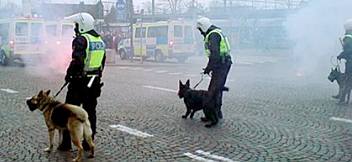
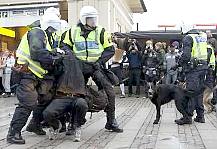
 For the officially permitted demonstration honoring Carl XII, approximately fifty individuals collected around this monument at the northern outskirts of Lund between 4 and 5 pm. The monument memorializes one of the worst bloodbaths, “the Battle of Lund” between the Swedes and the Danes around 1676, and has got nothing to do with Carl XII. Carl XII died on the 30th of November 1718 in Norway, fighting the Norwegians.
 […]
[…]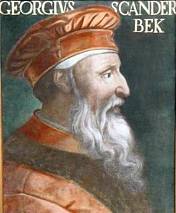 I just want to clarify that the majority in Albania, more than 90%, are pro-European. We lived under the Turks for more than 600 years and thus these damn invaders left their sign on this nation. But now that they are gone all of Albania wants to turn its face toward Europe. We are ashamed of being converted to Islam and now everybody (the majority, and after some decades all of Albanians) wants to turn the page.
 Besides the latest from Mumbai, the most interesting news tonight concerns the BNP. The Labour government’s policy of overt persecution towards the BNP and other dissenters has backfired, and the BNP is gaining in strength. There are a couple of reports below about yesterday’s BNP demonstration in Liverpool, which was mounted as a response to the arrest of three party members for handing out leaflets.











