Showing posts sorted by relevance for query slave traders. Sort by date Show all posts

Saturday, October 17, 2009

The Evils of Colonialism

Slave shackle

The photo above was taken in about 1907, and shows a British sailor sawing the shackle off the leg of an African slave.

Where was that slave bound before he was freed by the British?

In 1907 there was no longer any market for slaves among white people anywhere in the world. In fact, there was probably no market at all for slaves except in black Africa or among the Arabs. In all likelihood that slave was going to be sold on the Arabian Peninsula or perhaps to African Muslims.

Who captured the slave?

He was probably captured by another black African from a neighboring tribe, either in warfare or as a part of a deliberate slave-taking raid. The Arabs rarely captured black slaves themselves, and this slave might have been brokered several times by African traders before arriving at his final owner.

In any case, both the slave-taker and the customer were almost certainly Muslims.

Yet white Europeans are to blame for all this. As our multicultural indoctrination has drummed into us over and over, white people are the cause of all the world’s evils, including the enslavement of Africans.

Somehow, perhaps through diabolical mind-rays, we induced the Africans and the Arabs to enslave millions of blacks and then trade them among themselves.

It just goes to show how viciously omnipotent we white people are.

*   *   *   *   *   *   *   *   *   *   *   *   *   *   *

Here’s the full story about the photo:
- - - - - - - - -
Rare ‘slave freeing’ photos on show

A set of rare photographs showing African slaves being freed by the Royal Navy have gone on show for the first time.

They are part of an exhibition marking the bicentenary of the abolition of the slave trade.

Samuel Chidwick, 74, has donated the photographs taken by his father Able Seaman Joseph Chidwick, born in 1881, on board HMS Sphinx off the East African coast in about 1907.

The photographs, on display at the Royal Naval Museum, Portsmouth, Hants, show a sailor removing the manacle from a newly-freed slave as well as the ship’s marines escorting captured slavers.

Mr Chidwick, of Dover, Kent, said: “The pictures were taken by my father who was serving aboard HMS Sphinx while on armed patrol off the Zanzibar and Mozambique coast.

“They caught quite a few slavers and those particular slaves that are in the pictures happened while he was on watch.

“That night a dhow sailed by and the slaves were all chained together. He raised the alarm and they got them on to the ship and got the chains knocked off them.

“They then questioned them and sent a party of marines ashore to try to track the slave traders down.

“They caught two of them and I believe they were of Arabic origin.

“My father thought the slave trade was a despicable thing that was going on, the slaves were treated very badly so when they got the slavers they didn’t give them a very nice time.”

Jacquie Shaw, spokeswoman for the Royal Naval Museum, said: “The museum and the Royal Navy are delighted to announce the donation of a nationally important collection of unique photographs taken by Able Seaman Joseph John Chidwick during his service on the Persian Gulf Station where the crew of HMS Sphinx were engaged in subduing the slave trade.

“The collection comprises a fascinating and important snapshot of life on anti-slavery duties off the coast of Africa.”

The exhibition, ‘Chasing Freedom -The Royal Navy and the suppression of the Transatlantic Slave Trade’, is being held until January next year to mark the 200th anniversary of the abolition of the slave trade.

The House of Commons passed a bill in 1805 making it unlawful for any British subject to capture and transport slaves but the measure was blocked by the House of Lords and did not come into force until March 25, 1807.

Mrs Shaw said that since the exhibition opened, members of the public had brought forward several historically-important items.

She said: “As well as these amazing images, members of the public have brought many other unheard stories of the Royal Navy and the trade in enslaved Africans to the museum’s attention including the original ship’s log of the famed HMS Black Joke of the West Coast of Africa Station.”


Hat tip: VH.

Thursday, November 08, 2007

Arab Muslim Trafficking in African Slaves

The United States is the main focus of world opprobrium for its historical involvement in the enslavement of black Africans. However, neither the Americans nor the Europeans were the primary traders of black African slaves. Most slaves in Africa were either taken by Arab Muslims directly, or sold to the Arabs by the victors in African intertribal warfare. According to some sources, more than 140 million black African slaves may have been trafficked by the Arabs in the centuries since the founding of Islam. These slaves lived in brutal conditions, and the majority died in transit across Africa, Arabia, or the Indian Ocean. Only a tiny fraction crossed the Atlantic to end up in what is now the United States.

The Arab traffic in African slaves has not ended. Even though slavery is officially outlawed in all Muslim countries, the practice continues to this day.

Below is a concise and useful video summary of the history of the Arab slave trade:


Some of the text in this video was taken from In the Name of Allah:
- - - - - - - - -
A comparison of the Islamic slave trade to the American slave trade reveals some interesting contrasts. While two out of every three slaves shipped across the Atlantic were men, the proportions were reversed in the Islamic slave trade. Two women for every man were enslaved by the Muslims.

While the mortality rate for slaves being transported across the Atlantic was as high as 10%, the percentage of slaves dying in transit in the Trans Sahara and East African slave trade was between 80 and 90%.

While almost all the slaves shipped across the Atlantic were for agricultural work, most of the slaves destined for the Muslim Middle East were for sexual exploitation as concubines, in harems, and for military service.

While many children were born to slaves in the Americas, and millions of their descendants are citizens in Brazil and the USA to this day, very few descendants of the slaves that ended up in the Middle East survive.

While most slaves who went to the Americas could marry and have families, most of the male slaves destined for the Middle East were castrated, and most of the children born to the women were killed at birth.

It is estimated that possibly as many as 11 million Africans were transported across the Atlantic (95% of which went to South and Central America, mainly to Portuguese, Spanish and French possessions. Only 5% of the slaves went to the United States).

African Slaves

However, at least 28 million Africans were enslaved in the Muslim Middle East. Since at least 80% of those captured by Muslim slave traders were calculated to have died before reaching the slave markets, it is believed that the death toll from 1400 years of Muslim slave raids into Africa could have been over 112 million. When added to the number of those sold in the slave markets, the total number of African victims of the Trans Saharan and East African slave trade could be significantly higher than 140 million people.


Hat tip: Steen.

Thursday, August 13, 2009

The Middle Eastern Passage

When most people think of the African slave trade, they picture evil white men — for example, prominent members of the Adams family in Boston — who purchased slaves on the west coast of Africa and shipped them to South America, the Caribbean, and the United States.

But those guys weren’t your typical slave traders. These were:

Arab slave trade
“Group of slaves with Arab men”

It’s important to remember that the bulk of the slave trade went in the opposite direction — from Africa to the Arabian peninsula. The Arabs have been enslaving Africans since prehistoric times, and the slave trade in Saudi Arabia wasn’t abolished until the 1960s. An underground traffic in slaves continues to this day, particularly in Mauritania and other countries in western and northern Africa.

The Arabs were the primary suppliers of slaves — the wholesalers, if you will — for European-owned ships that made the Middle Passage. The Arabs had long-established raiding-and-trading routes in Africa that no European could hope to match, so they continued to dominate the market.

The photo above was taken in 1868, and the flow of slaves from Africa to Arabia continued for almost a century after that.

Here’s the account that was posted along with the photo:
- - - - - - - - -
“Group of slaves with Arab men”

Zanzibar, 1850-1890

The Indian Ocean Slave trade evolved around the Indian Ocean basin. Slaves were taken from mainland East Africa and sold in markets in the Arabian Peninsula and the Persian Gulf. In contrast to the trans-Atlantic Slave Trade, the Indian Ocean Slave Trade was much older dating back from at least the second century C.E. until the early twentieth century. For example, the oldest written document from the East Africa Coast, the Periplus of the Erythraean Sea, describes a small trade in slaves around the second century C.E.

The idea that Muslims, particularly Arabs, are somehow friends and comrades in suffering with American blacks is the Big Lie of the 21st century. Nothing could be further from the truth.

The truth is that Muslims have been slaughtering and enslaving black Africans for more than a millennium.

The truth is that black African Muslims have the lowest status of any group in Islam, and are held in special contempt by Arabs.

The truth is that Muslim immigrants to the United States have appropriated the rhetoric of civil rights for their own ends, and are cynically exploiting African Americans in an attempt to Islamize America.

You won’t hear much about these truths in the mainstream media. It’s not a story that people want to hear, because it doesn’t fit the “dominant narrative” of white patriarchy and oppression.


For more information the African slave trade, visit this page on the same website.

Hat tip: spackle.

Sunday, October 18, 2009

The Islamic Trade in African Slaves

We live in a politically correct time.

Under the core tenets of multiculturalism, all evils in the world are assigned to white Europeans. The trade in African slaves is represented as one of the foremost examples of white evil, and virtually the entire historical focus is on the Middle Passage from West Africa to the New World, in which white men play the part of primary villains.

What is generally ignored is an inconvenient truth: most black African slaves were in fact captured by Muslims and carried off to North Africa and the Arabian Peninsula to serve Muslim masters under the most brutal conditions imaginable.

A recent German documentary has gone a long way towards rectifying this historical amnesia. A subtitled version is below, divided into five parts. Many thanks to VH for the translation and Vlad Tepes for the subtitling:

Part 1 (introduction):


Part 2:


Parts 3 through 5 and a transcript are below the jump.
- - - - - - - - -
Part 3:


Part 4:


Part 5:


The entire program is also available on SevenLoad as a single video.

The transcript below is a slightly different version than the one that was used for subtitling:

00:05
Quite a while ago.
In the thirties.

00:08
A report by the famous writer
Joseph Kessel.

“Slave Markets”

00:12
On the front page of the French
newspaper Le Matin.

00:18
In the heart of black Africa,
Kessel encountered something …

00:26
… that should have long ago
been relegated to the past… trade in humans.

00:28
With his own eyes he saw the caravans; men,
Women, and children, exhausted, chained.

00:37
Kessel wrote: “The ancestors of these
unfortunates had been raided for generations, …

00:46
… kidnapped and sold.
A provision store for human cattle.”

Doc en Stock/Arte France presents:
00:56
Kessel had spoken to those slaves.
One of them told him:

01:02 (female voice)
I can’t remember where I came from.

01:04
A long time ago my village next to a large
forest was set on fire.


01:08
Some men took me with them.

01:10
With great effort I had to march
long distances with them…


01:14
I had many masters and many children.
But I don’t want to think of them anymore.

.
01:18
The masters sold me.
They took my children away.

01:24 (voice over)
The overseers were Arabs, who drove their
human herd to Saudi Arabia and Yemen.

01:36
Kessel’s report caused a furor in Europe then,
but the matter was soon forgotten.

01:44
The Forgotten Slaves; Slaves for the Orient
A film by Antoune Vitkine

02:03
75 years later. For a long time the UN, with UNESCO,
have appointed a preserver of culture and history …

02:10
… to act as a sound box that rings the bell
for our collective memory.

02:16
As it does every year, UNESCO organizes a worldwide
commemoration day for slavery.

[On behalf of UNESCO I thank you for your cooperation in the commemoration of the greatest human tragedy, slavery]

02:21
But none of the renowned speakers addresses
the events on which Kessel reported in his time.

02:26
The trafficking of humans to the Arab
countries was completely hushed up.

Excerpt from “The Slave Route, UNESCO, 2004

02:31
”On behalf of UNESCO I want to thank you greatly
for the commemoration …

02:35
… of one of the greatest tragedies of humanity,
the trade in Negroes and slavery”
02:49
Human trafficking of black people was brutal
and inhuman, but was written in history on four continents.

02:55
[The cells measured 2.6 x 2.6 metres, and had 15 to 20 people in them]

02:59
The starting point for transatlantic trafficking
was the island of Gorée, off the coast of Senegal.

[They sat with their backs to the wall.
And their necks and arms were chained.]


03:05
A heinous place, but now a tourist attraction.

[In the middle of the chains hung a large ball which the captives had to carry between their legs.]

03:10 [Boubakar Joseph Ndiaye, curator of the memorial on Gorée]
”For 350 years they were hunted, snatched from
their homelands and roots, tortured, and humiliated.

03:14
“They were kept in groups of 15 to 20 in cells of 2.60 by 2.60 metres …

03:19
… chained by their necks and arms to the wall.”

03:24
The chains had a large ball they had to carry between their legs”

03:30
For three hundred years they were relentlessly tracked and hunted.

03:34
They were snatched from their homelands, taken from their roots, tortured and en humiliated.”

03:43
According to this map as used in schools,
over a time span of 350 years

03:49
twelve million black Africans were transported…
…to North and South America,

03:56
by Europeans.
[part of the film, “The Slave Route”, UNESCO, 2004]

04:03
An unscrupulous, inhuman business
in barbaric conditions.

04:07
An uncompromising commitment
to racism…

04:10
… degrading the black population
to the status of “untermenschen”.

04:20 [female voice]
“Most civilizations have known slavery,
but nowhere were they in any way comparable …


04:26
… to the transatlantic trafficking.”
04:33 [voice over]
Not comparable to the transatlantic trafficking.
That may be so.

04:38
But then just simply leave another, just as
cruel slave trade under the table?

04:45
Millions of people from Senegal and other
African countries …

04:49
… were shipped to the Americas.
But in the same way to the Arab Islamic world.

4:54
Recent research estimates this encompassed
fifteen to seventeen million people.

Thomas Vernet, historian, University of Paris

04:59
And this human trafficking after all
lasted some 1400 years …

05:03
… from the 7th until the 20th century.
05:16
Can one simply tick this off with just a
few dots on the UNESCO map …

05:20
… although renowned historians have been
studying this issue?
05:28
These slaves must finally be released
from their shadowy existence.

05:33
They were the victims of yet another variety
of the trade in human beings.

05:37
And through our studies they should finally
be granted an honored rest.

05:43
Salah Habelzi is one of the most renowned
experts on the Muslim slave trade.

05:49
Also he is perplexed
about the ignorance.

05:52
Recently I took part in a
conference in Morocco.


05:59
One of the speakers took
the stage and said:


06:03
“I do not understand how one can compare
or connect the slavery in Islamic countries …


06:13
… with the other forms of slavery.
With us the slaves were always treated well.”

06:24
Why is this story hushed up not only in Arab countries,
but also in Europe, and indeed the whole world?
06:36
Since primeval times there have been slaves.
With the Egyptians, the Greeks, and the Romans.

06:46
But while Christianity abolished it
in Western countries …

06:50
the Arab world remained
faithful to this tradition.

06:57
In the 7th century after Christ,
the situation intensified.

07:01
Islam was expanding.
Muslim troops pushed into new areas …

07:06
… and soon controlled
vast territories.

07:11 [Mohammed Ennaji, historian, Univ.Rabat]
It is known that as Islam expanded,
there was a sensational number of labourers.


07:23
The campaign of conquest also had as its aim,
apart from the expansion of the empire …


07:28
… to catch humans
and enslave them.

07:35
They were desperately needed for the many
building projects planned everywhere.
07:42
Soon, slaves were a familiar sight
in the entire Islamic world

07:48
Their function was even more
important than …

07:59
The Muslim Arab empire established itself,
and with that, the slave trade.

08:05
Like the overseas trade, trade in
fresh meat was also organized by profiteers.

08:11
A powerful dynasty of traders dominated
the business. For instance in Cairo.

08:18
From medieval times up to the 19th century,
there was even a cartel for the slave trade, …

08:24
… which divided the state orders.

08:28
And since religion in the Islamic world
rules the entire society …

08:31
… it also involved itself with slave trade.
The Quran, however, advises

08:36
not to treat slaves too harshly, but offers
nothing to apply against this praxis.

08:41
Slavery was not justified by religion,
but it does offer rules for slavery.


08:48
The point is that its society in practice
is based on disparity,


08:52
and this is accepted and justified
by its religious texts.


08:59
The Quran often mentions slaves
without putting their status in question.


09:04
And that is not surprising, because those
were simply the conditions at that time.


09:09
And this society would have been
unimaginable without slavery.

09:18
In principle, Islam allows slavery, under the precondition that slaves are not Muslims.

09:25
And in this way over the centuries, hundreds of thousands,
if not millions of Europeans were enslaved.

09:31
But the Western world resisted this.
And because white slaves grew ever harder to get,

09:37
… the Muslims turned their focus on Africa
to look for slaves.
09:57
On the black continent live many
black Muslims.

10:01
But the Quran forbids enslaving
fellow Muslims.

10:05
This contradiction though was soon overcome.
10:12
Parallel to the advance of Africa as
the most important slave supplier …

10:16
… in the Arab states a racism developed
that justified the trade in human beings.

10:21
This was not much different though
from the Americas.

10:27
Long before 19th century European anthropologists
formulated their well known theories on race …


10:34
… the inferiority of the black race was posited
as a near undeniable fact in the Arab world.


10:41
And this by highly respected scholars
such as Ibn Khaldun.

10:49
Ibn Khaldun, the great politician and historian
of the 14th century, wrote:

10:54
”The only people who accept slavery
are the Negroes …

10:58
… because they are inferior to other humans
and in their nature look like animals.”

11:04
Certainly there were many,
I have proven that.


11:07
Many designations and a viewpoint …
that classified the black race, the slaves …


11:13
… as inferior.
11:18
In Arabic there are different words for “slave”.
One can say Abt, Golem, Zanj or Aswad.


11:28
Interesting is that “Aswad” at the same time
means “black”.


11:32
Also “Zanj” took on a meaning that was used
for blacks from East Africa.

11:39
We can see how original ethnic or regional
meanings developed to synonyms for “slaves”.

11:50
Even today in the Maghreb countries, for instance
in Tunisia, one calls a black “Abd”, a “slave”.

12:06
Following these theses, during 1400 years
there were people enslaved.

12:11
Soldiers taken prisoners during wars were provided
by traders with orders to hunt humans.
12:20
These hunts were accompanied with
unbelievable violence.


12:28
They set fire to houses, and frontally attacked
the completely defenseless population.

12:37
Then these people were brutally snatched
from their families and homelands.

12:48
For every captured slave on average
cost the life two to three others.

12:57
And in the villages awaited
very valuable goods.
13:07
One of the articles in demand
was children.


13:12
They adapted more easily to a new environment
and new circumstances.


13:16
Therefore they were easier to control
than adults …


13:20
… who did not easily accept
being slaves.

13:32
Once captured, whether child or adult,
a long period of suffering began for the slaves.

13:40
Over 1400 years the slave trade followed
the same schedule.

13:45
But where in America this was addressed
in the history books …

13:49
… the traces of the other slaves
vanished in the sands of the Sahara.
13:57
Seven million humans were forced
to march through the desert …

14:01
… guarded by Ghalabs, cattle drivers,
who did not distinguish slaves from animals.
14:10
When the captives after three months
reached the North or East coast …

14:14
… they were fully exhausted.

14:17/14:19
Some studies suspect that the first marches
on the African continent …

14:23
… caused the most human sacrifice.
14:30
Only those with a strong constitution made it
with the caravans to the destination.
14:40
Water shortage, illnesses, exhaustion.

14:43
20-30% of the captives stayed behind …

14:47
… a mortality rate that comes close
to that of the transatlantic slave trade.
14:56
Further transport was with ships.
To the Arabian peninsula or to Cairo.

15:03
Well into the 20th century there were still
slaves shipped over the Red Sea.

15:08
In total some 8 million people.
15:12
Packed together in dhows, the typical sailing ships
that were certainly not more comfortable
than the ships to America.

15:29
This operation was fatal for 70-80%,
a number that points at the scale of the massacre.

15:38
This also explains the extraordinary market value
of eunuchs.

16:04
Despite all these cruelties, the Arab slave trade
still flourished at the beginning of the 20th century

16:10
Without ever being called into question.

16:16
Where one in the old days had to rely on drawings
and documents, now there were photographs.

16:23
In 1880, English travelers encountered ships
with slaves and captured it with cameras.

16:36
They came from the island of Zanzibar,
off the coast of Tanzania.

16:40
Since the 18th century the pivot point
of the slave trade.

16:45
Zanzibar was as transshipment point
at least as important as the Senegal island of Gorée.

16:51
But that has been completely forgotten now,
and visitors are hardly ever welcomed here.

16:57
Yearly, there were 115,000 slaves
imprisoned here.

17:02
Under the worst conditions, before they were
transported to the Arab countries or Brazil.

17:11
The more than century-old photographs
testify to the conditions.

17:40
In this remarkable picture, slaves are seen at work.
On a spice trade plantation.

17:49
In 1830 there were hundreds of thousands of slaves
working on the plantations of Zanzibar.

17:54
Under similar conditions as in
North and South America.

17:58
The plantation owners did not care about the needs of their workers,
and the mortality rate was unusually high.

18:09
A small group of planters ruled over a herd
of servants who did the bulk of the production.

18:16
This system was called a “slave company”

18:20
This meant: the slaves represented the largest part
of the company, but had no influence …

18:27
… on the social fabric, although it largely depended
on the productions of their labor.

18:37
The palace of the Sultan testifies of the wealth
that could be earned from the trade in humans.

18:44
Again a comparison emerges with the European slave companies and its pivotal points.

Background: “Launching the United Nations International Year to commemorate the struggle against slavery and its abolition by the director general of UNESCO – Goree Coast Castle”

19:06
But the African slave market has another side
which is ever memorialized.

19:16
For that side, 2004 was proclaimed the International Year to commemorate slavery.

19:24
After the celebration speeches, a theatre play which in the truest sense displays a black-white view point.

20:02
Not a word that Europeans were not
the only bad guys, but also the Arabs. And the Africans.

20:17
For the history of slavery also has grey zones.
Though to many that is too complicated.

20:30
The widely-renowned historian Ibrahima Thioub
is one of the few Africans to make a study
of this side of the slave trade.

20:40
One of the few who also denounces the African profiteers
in the transatlantic and Arabic trade.

20:54
Did the slaves just fall out of the sky?
Somebody must have come up with them.
There is not a power in the world that has
the political, economic and technical capabilities …

21:04
… to simply sail to the African coast,
penetrate the inner continent …

21:10
… gather the people from the villages,
and take them out of the country.
21:21
There were certain social groups in Africa,
the African elite …

21:26
… who understood how to exploit
the export of these communities.

21:31
They were the middlemen of the slave trade
and had built a truly efficient system.

21:36
The moral aspect did not play any role then.
Only in this era do we have moral problems.

21:45
— The Africans first had to learn from
Europeans what slavery is.

21:50
— And now the question arises:
Can victims also be guilty?

21:54
— But we prefer a simple scenario in which it is clear who are the bad and the good.

21:59
— With this the order is often not quite unambiguous.

22:10
For hundreds of years, their African warlords sold their captives
as slaves to Arab and European traders.

22:36
This intermediary trade is one of the largest …
[end section 22:38]

22:42
A slave is alien to others. Whoever enslaves strangers
will always find justification to view them as savages.

22:50
Many peoples considered their neighbors
as being uncultivated. One could easily say:

22:54
a savage is just another expression
for “the others”.

22:59
Things had also been like that
in the old wars.
23:08
Such slaves mostly are prisoners of wars
that African nations were constantly waging.
23:17
In medieval times the empires of Ghana
and Mali enslaved tens of thousands.

23:27
The impression is that it was usually
military troops, that went through the land …

23:31
… and mostly caught woman and children.
The men were simply killed.

23:35
That is different from society to society.
Also abductions occurred.

23:40
This of course causes great uncertainty,
for one not only should be alert in time of war,

23:45
but it can happen anytime that one’s wife,
son or daughter …

23:49
while taking a walk is captured
and carried away.

23:53
From Mombassa there were several reports
that children were kidnapped and sold elsewhere.

22:59
Then humans suddenly become trade goods.
One sees a child and does not think:

24:03
”what a beautiful child”, but
”that one can make a profit for me”.

24:07
A perverse thought.

24:10
And that is why slavery
is a disruptive element for society.

24:15
One begins to judge humans on their market value;
human relations become irrelevant.
24:33
Often village chiefs sold children and adults
to pay off their debts.

24:39
Since the old days, slavery has been a red thread
running through African history.
24:44
Trade in humans, hidden, without witnesses,
without denunciation.
24:58
The arrival of Europeans became a turning point
in the 17th century. The demand explodes.

25:05
Not just the usual demand had to be covered.
There were also the white gentlemen who wanted black slaves.
25:13
The transatlantic slave trade caused an unusual
outbreak of violence in African communities.
25:24
Kingdoms flourished and had owed their wealth
exclusively to the slave trade.

25:29
They waged endless wars to ensure
the supplies.

25:34
In the 19th century the inter-African slave trade
reached its peak.

25:39
The system collaborated. Many societies
had as many free people, as slaves.
25:52
Whether Arabs or Europeans, the entire world
took part in the black slave trade.

25:59
And for a long time nobody has put the
ruling viewpoints in question.
26:14
But then the Western world came
to denounce this barbarity.

26:19
To Europe came the Enlightenment. Freedom.
Equality, brotherhood, is the new answer.
26:28
In the 19th century, slavery
was abolished in Europe.

26:32
Also the slaves in the French Antilles
demand their freedom.
26:38

Petition against the slave trade in Senegal.
The Chamber of Deputies [J. Morenas]

26:45
Now the public openly condemns the practices
they had been accepting for so long.

26:51
And is appalled by the cruelties of both
the Atlantic and the African slave trade.

26:58
In the newspapers, expressive illustrations
and descriptions are published.

27:02
Petitions are signed.
27:12
The struggle against slavery was used as
a justification for colonization.
27:21

“Algerian Company”
27:28 [Mohammed Ennaji, Historian, Univ.Rabat]

In Zanzibar the English stop the slave ships
and further trading …

27:32
… and they incorporate the island
in the British empire
27:39
In the Maghreb and West Africa, the French
liberate the slaves and take command.
27:49
The abolition of slavery therefore
was enforced upon the Africans and Arabs.

27:56
And that had consequences.
28:02
— The disappearance of slavery in most Muslim
countries is clearly due to external influences.

28:09
Just as the modernization of the economy and
social structures was influenced from abroad.

28:16
The western world became a global power.
And in this way slavery was abolished.

28:21
Promoting development of modern societies
was not limited to just a few countries.
28:29
In countries where slavery was most common,
like Morocco, it disappeared almost unnoticed.
28:37 [Ibrahima Thioub, historian, University of Dakar]
I think this is an important aspect.

28:40
It disappeared without ever having been
addressed as a problem.

28:44
Which is a pity …

28:46
Because I think it would have been
of great use if this had been addressed.

28:52
That might have been an important step
on the road to modernity.
29:06
Also black Africa on its difficult road to
independence stayed silent on this topic.
29:15
One prefers to forget the problem
that others have cleared out of the way.

29:22
— This can be difficult
for the African consciousness.

Ministry of Culture — House of Slavery

29:26
Politically seen, Africa was not involved
in the abolition of slavery.

29:32
But the unity needed for the anti-colonial struggle
would never have been possible …

29:37
… if one had addressed the
contradictions in certain African communities.

29:42
They therefore massively ignore this,
and prefer to focus on their shared problem:

29:47
… The Occident.

The moment has come to close this chapter.
30:03
Why is it so hard for UNESCO, the keeper of world heritage, to demand an account of all involved?

30:12
Ali Moussa, leader of UNESCO project “The Slave Route” has assigned himself on a difficult task.

30:18
Over and over he appeals to the member states to finally engage themselves on this issue.

30:24
And often encounters resistance.

30:29 [Ali Moussa Iye]
— Many countries show themselves unwilling,
I honestly have to admit that.

30:33
—The problem recalls
bitter memories for them.

30:36
— Old wounds are open here,
and strong emotions released.

30:42
In any case there is the resistance form the side of the governments, the political decision makers.

30:47
But often also from the side of the population.

30:51
As I mentioned, this is a most delicate matter,
that is why the reserved attitude is understandable.

30:58
For many this would really open a Pandora’s box,
with all possible consequences.

31:03
Many would possibly regard it as
an admission of guilt.

31:06 Representation of the Arab League to UNESCO

31:10
Guilt…
A word that causes fear.
31:17 [Nassif Hitti, Arab League Ambassador]
Are the UNESCO representatives
of Arab countries …

31:20
… prepared to admit their complicity
with the slave trade?

31:24
And eventually show their regret?
31:27
When one talks with Africans, they of course
do not enthusiastically address the issue of slavery.

31:32 [woman’s voice]
— Is this chapter closed?

31:35
Then that is a general requirement.
And slavery itself is of course condemned.

31:40
The problem only existed under certain circumstances
that hardly ever occurred in the Arab world.

31:47
I believe many want to make it a big issue,
those who maybe have anti-Arab or anti-African views.

31:56
They generalize this problem
and exaggerate it disproportionately.

32:02
I might as well say then: I don’t want anything
to do with the Occident …

32:05
… because they
undertook the Crusades.

32:14
I certainly do not want to avoid this matter
and fully and completely condemn slavery.

32:19
I would appreciate if some European countries
showed more courage addressing this problem.

32:24
Especially with colonization
in hindsight.

32:27
Bit not many intellectuals do that, and from
the official side not much comes about.

32:37
From the official Arab side, no preparedness
to admit responsibility for the slave trade.

32:44
One rather keeps the focus on
European colonization.

32:52 [Tidiana N’Diaye, economist, anthropologist]
The ruling strata in African countries, for a large part Muslim shaped, show solidarity with the Arab world.

33:00
I am therefore very much interested to take on
the account of this history.

33:08
Here one believes that everything bad
can only come from the West …

33:12
… but never from their Muslim neighbors
to the North.

33:15
North Africans and many in Middle Eastern states
have become good friends of African nations.

33:23
This of course developed
behind the back of the West.

33:26
And it was agreed upon not to reopen
this painful chapter.

33:37
But there are also brave historians and other
intellectuals who dare to point at this history.

33:44
Often withstanding the resistance
of their own people.

33:47
One of them is professor Tioub.

33:50
One event has formed him:
the conference in 2001.

33:55
Because he had dared to deviate
from the main theme …

33:59
… that was established in advance,
and he lecture on all forms of the slave trade.
34:04
How did the audience respond?

34:07
In the audience were Europeans and Africans.
I purposely do not say black and white …

34:11
… although that would also
have been appropriate.

34:17
To me, the problems that I addressed
had nothing to do with skin color.

34:22
There were quite commonplace questions.
No core issues.

34:25
And I had not expected an unusual response
from the audience.
34:30
The audience, most of all the Africans,
responded with a fury that totally surprised me.

34:35
I had never thought that this theme could be
such a hot issue.

34:39
That it could cause such emotions.

34:42
I was really not aware of that.
34:48
I heard voices from the audience that said:

34:51
”You are telling fables.
Those are generalizations.”

34:55
But there was no scientifically based criticism.

34:59
The reason why I found out immediately afterwards.
35:05
After my lecture, which provoked such aroused
and unqualified expressions, I left the hall.
35:18
Then some Africans came to me there.

35:25
They were not many, but what they said
seems reasonably representative to me.

35:32
They said: “Your statements are quite right,
one should absolutely study that aspect more.


35:38
But you should not address such matters
in front of a white audience.”


35:44
And Europeans came to me, separately of course,
and said: “Congratulations, I think like you.”

35:53
Bit you have the courage to express it.
I would not dare to …


35:57
… for they would call me a racist.”

36:01
After I learned of both these views,
which I could understand very well …

36:06
… I asked myself: where are the historians?

36:09
It is about time to take the bull by the horns.
36:19
Without doubt, Ibrahim Tioub’s explanations
were much too complex for a simple truth.
36:31
In a time in which fear makes people blind.

36:35
The fear of a heritage of cruelties
with still unhealed wounds.

36:50
Also in the West the real truth of slavery
has never really been opened up.

Saint Antoine d’Exupéry

36:57
Ignorance or shared guilt, …

37:01
… one does not want to hassle
the former colonies with it..

37:05
Or, on the contrary, is it out of the aftermath
of the old feelings of superiority of the white race …

37:11
… that all alone they now take over
the responsibility for the past.

37:15
That they only address their own regret.

37:18
That would be a very subtle form
of underestimating other peoples.

37:22
One judges themselves to be capable
of committing such a crime.

37:47
Antoine de Saint Exupéry described in “Wind, Sand and Stars” of 1939, a scene he witnessed in Morocco.

38:00
— Occasionally, a chewing black slave
in front of the door enjoys the evening wind.

38:05
— In this body become plump due to a life
of in captivity, no memories rise up again.

38:12
— For he now has become too old to earn simple clothes.

Tuesday, October 23, 2007

Yorkshire Miner Visits The Belly of the Beast

Here is another report from the Vigilant Freedom Conference. This one is interesting because of the pictures -- not of the attendees but of the sights outside


The last few days I have spent in Brussels attending a conference organized by the Vigilant Freedom Europa. I suppose we will be called right wing fascists by the left because it was about the danger of Islam in Europe.

[…]

On the second day of the conference I walked down through Jubel park to Robert Shumans plads to get a taxi to the venue. Just a few yards away is the European Commission building. What caught my eye though was a minaret sticking up above the trees just to the left of the park entrance. Curiosity got the better of me and I wandered across to take a closer look. The mosque turned out to be the Grand Mosque of Brussels built with Saudi money on land given to the Belgium muslims by the late King. It is no more than about 200 yards from the E.U. Commission building.

I took a picture and then wandered back towards to main gate to get my taxi.


To get there I had to go past this monument. It must have been very impressive in its day, but the past 100 years have ravaged it. As you can see it is black and eroded. One would have thought that the Belgian people would have would have taken care of it because it is about ending the slave trade in the Congo.

I didn’t know this until I wandered over to read the inscriptions. Well, the part of the inscription that I could read because certain vandals in Belgium society had vandalized it -- it is not difficult to see why. Here is my rough and ready translation to my readers who can’t read Flemish or French:

“The Belgium’s military heroism in destroying the Arab Slave traders…”

Well you can’t read the bit where it says “Arab” in the French inscription because someone has taken a chisel and chiseled it away, but you can decipher it in the Flemish inscription. You can also see that it has happened before because both words have been repaired.

It seemed symbolic to me about the problems we are suffering in Europe today. We allow them to build propaganda offices under the guise of mosques, then do nothing when they try to eradicate our history by disfiguring our monument.

The monument is certainly not on a par with the Giant Buddha statues in Afghanistan, but you can bet your life it will be the first thing they blow up when they take power.


Go see his other pictures, especially the mosque. Yorkshire Miner has an eye for composition and this mosque image really captures the spirit of the place.


[post ends here]

Wednesday, July 12, 2006

The Men of the North

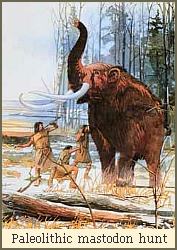
Paleolithic mastodon huntFor the tens of thousands of years of the Würm glaciation, Paleolithic hunting tribes lived at the southern edge of the ice fields in Europe and Asia. About 10,000 years ago, as the last of the glaciers receded, some groups chose to follow the retreating ice northwards. While their cousins in the warmer regions to the south were smelting metal, these hardy tribes were knapping flint. While the southerners were inventing agriculture, slavery, and the ziggurat, the northerners were hunting large game in the chilly grasslands and forests of Central Asia and Northern Europe.

One such group arose in the steppes of Central Asia, shifting to the Neolithic era by taming the horse and other livestock. These folk lived a nomadic existence, migrating in all directions during the last several millennia before the birth of Christ. For want of a better term, they are known as “Indo-Europeans”, in reference to the language group their descendents propagated throughout the western half of Eurasia.
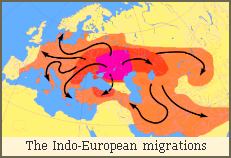
The Indo-European migrationsSome of the migrants turned south, invading, conquering, and taking up the ways of the city-states in the Indus Valley, Anatolia, and the Mediterranean basin. Other branches moved westwards and northwards, both in Europe and in Asia, displacing the indigenes and even opening up ice-free territory to humans for the first time.

Two major waves of Indo-Europeans migrated into Western and Northern Europe. Celtic tribes swept through Central Europe to take up residence in what is now Germany, France, the Low Countries, and the British Isles. Later Germanic tribes pressed on after the Celts, supplanting them in many places, moving northwards into Scandinavia and pushing the ancestors of the Lapps and the Finns further up the Baltic and into the Arctic.

The Celtic and Germanic tribes were closely related; some ethnologists consider them to be two branches of the same group. Their cultures were similar; they traded with one another, fought with one another, and presumably intermarried. But all across northern Europe the Germanic tribes nevertheless pushed the Celts further and further west, until their last remaining outposts were the British Isles. The Romans assisted the Germanic conquests by hiring Frankish tribes as mercenaries against the Celts in Gaul.

After the fall of the Roman Empire, the now-ascendant Germanic tribes of the Low Countries, Jutland, and northern Germany saw their opportunity. During the 5th and 6th centuries A.D., wave after wave of tiny boats carried these various German tribes across the cold North Sea to Britain. They massacred or drove out the Romanized and Christian Celts, pushing them west and north, and stayed on to till the soil and raise livestock.

Three major groups descended on Britain. The Jutes, originating in Jutland and Holstein, settled in what is now Kent. Meanwhile, the Angles came from northern Germany, particularly Schleswig, and settled in Norfolk and Suffolk. The Saxons migrated from the region between the Elbe and Weser valleys in northwest Germany to occupy south-central England and what eventually became Wessex.

But, of course, this account simplifies a chaotic mélange of related tribes who mixed and feuded with one another as well as with their Celtic neighbors.

As the country was subdued, the settlers established Anglo-Saxon kingdoms in the region of Britain south of Hadrian’s Wall and east of Offa’s Dyke. The Christian Celts were driven into Wales and Ireland, while the pagan groups speaking more or less mutually intelligible Low German dialects occupied what is now England.

As the Anglo-Saxons were converted to Christianity, the kingdoms of England became less chaotic and violent. With stable farming communities, a literate clergy, and a system of inherited kingship, Britain adopted the general model of contemporary European Christian culture.
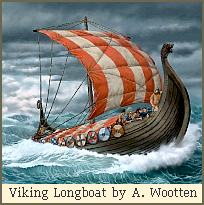
Viking Longboat by Antony WoottenBut to the north and east the Scandinavian tribes still seethed with pagan violence. As their numbers increased, there was little territory into which the surplus population could expand. The available arable or pastoral land was limited, and inland from the fjords were slopes of rocky scree, and then the glaciers.

So the tough and pugnacious younger sons took to the sea in their longboats, and the age of the Viking raiders began.

*   *   *   *   *   *   *   *   *   *   *   *   *   *   *
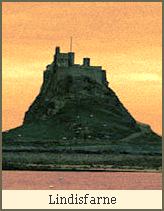
LindisfarneWhen the monastery at Lindisfarne in northern England was sacked by the Vikings in 793, it was recorded by the Northumbrian chronicler Alcuin as an event of unspeakable brutality. Yet two and a half centuries earlier it was Alcuin’s ancestors, the heathen Saxons, who had slaughtered and raped their way through the Christian communities of Britain. The Vikings were scarcely different; they were just late to the game.

Over the next two or three centuries the relentless Vikings raided their way across Europe. From Greenland to Algiers, from Labrador to the Volga, the Vikings made their presence felt. From Sweden they crossed the Baltic and rowed up the rivers into Russia. They ported their boats across to the Don and the Dnepr and the Volga, and sailed to the Black Sea and the farthest reaches of southeastern Europe. Rounding Gibraltar, Vikings raided the Mediterranean coasts of Iberia, Italy, and Muslim North Africa. The Vikings even had the rare distinction of taking Arabs as slaves.
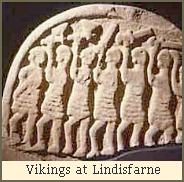
Vikings at LindisfarneBut, despite the conquest and slaughter, and unlike the Arabs (who were dedicated slave-traders), the Vikings did not generally take slaves during their raids. Perhaps the necessity of rapid movement by sea and the long passages through the cold northern waters discouraged the practice.

The Vikings were otherwise dedicated traders, establishing fortified mercantile settlements wherever they went. The Norse Vikings, after plundering the many rich monastic targets in Ireland and northwestern Scotland, established trading centers which became Dublin, Limerick, and other major Irish cities. In their wake they left their blond-haired genes to supplement the black hair of the Celts.

What made the Vikings different from the Anglo-Saxons was their failure to impose their culture on the people they conquered. They were content to rule and prosper, adopting the language and customs of the people they defeated. The different branches of Viking invaders — the Rus, the Normans, the Danes in England, the Norse in Scotland and Ireland — became, after two or three generations, indistinguishable from the folk they conquered.

When Danish Vikings invaded and occupied large sections of England, the result was to cement the unity of the Anglo-Saxons against them. The English accepted the Danelaw in northeastern England. They paid the Danegeld; however, over the next century the English gradually incorporated the Danes and merged with them.

Their two cultures and languages were similar; hundreds of Old English words were so close to Old Norse that Danish versions supplanted the English ones. When the heathen Vikings converted to Christianity, there remained little to distinguish them from the English. By the time the Danish king Canute became king of England in 1017, the Danelaw and England had become a single culture.

*   *   *   *   *   *   *   *   *   *   *   *   *   *   *

In 1066, England was conquered by a different group of Northmen, from across the English channel in France.

These Normans were descendents of the Vikings who had raided and plundered in northern France. In the process of settling there, like Vikings all across Europe, they had forgotten their own language and culture and had taken on that of the people they conquered. Consequently, when the Normans abolished the Anglo-Saxon aristocracy in England and established their own legal system, they were importing a variant of ancestral Roman law.

Like other Mediterranean cultures, Rome had possessed political and legal structures whose lineage could be traced all the way back to the earliest city-states of Mesopotamia. For thousands of years the polities of the region had been centralized agricultural city-states, with rigid hierarchical structures and elaborately bureaucratized administration.

Conversion to Christianity did not change this ancient underlying worldview. Thus, God granted authority to the sovereign, who in turn dispensed justice and mercy to his subjects. Any rights the common people possessed were passed on to (or withheld from) them by the sovereign. This was the natural order of the world, and had been so for time out of mind.

I call this southern system of governance the “Pharaonic model”. It widely diverged from and was in conflict with the ways of the Normans’ English vassals. Their northern practice was represented by the yeomanry, the society of free-born petty landholders, who governed themselves by time-honored Anglo-Saxon custom.

This is not to say that the Anglo-Saxons had no hierarchy. However, it was a shallower and more fluid system than its Pharaonic counterpart. Anglo-Saxon governance was based on the prowess and virtue of those who were deemed noble, and instead of a Pharaoh there was a Cyning, a King, who represented his folk as their exemplar, rather than as their ruler.
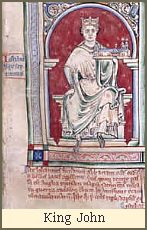
King JohnA yeoman’s rights were granted directly to him by God and could not be revoked by his sovereign. The Normans, in order to rule their new lands successfully, were required to recognize the “ancient liberties” of their Anglo-Saxon subjects. When his rebellious barons compelled the Norman King John to sign the Magna Carta in 1215, they were simply retaking their ancient liberties. The customs of the men of the North thus survived despite the Normans and became the English Common Law.

Over the next four centuries the Common Law was elaborated into the English Constitution, with its Parliament and system of justice. This, then, was the political model that the English settlers carried in their minds when they debarked into the mosquito-ridden swamps of Virginia in 1607.

*   *   *   *   *   *   *   *   *   *   *   *   *   *   *

English governance was transplanted successfully to North America, but the character of the new land was not solely English. The landless younger sons of the gentry, the fugitives and criminals, the religious refugees, and the political outcasts who initially came to America were drawn from the most adventurous and entrepreneurial of the Anglo-Saxon and Danish bloodlines.
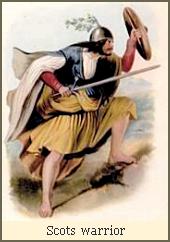
Scots warriorThese, in turn, were soon supplemented by massive numbers of Celts, first the Scots-Irish, driven by poverty and political maginalization. They pushed beyond the English settlers into the Appalachian highlands. After the Revolution, they in their turn were supplemented by waves of surplus Irish. Near where I live in Virginia, there was a large Welsh community, drawn here by geography: the ample deposits of slate created a demand for their well-known quarrying expertise.

With a tradition of fierce independence and a martial spirit, the Celts were scarcely governable except on their own terms. Combined with the yeoman small-holders from the English tradition, they formed the basis of what is now “redneck” culture, and were the backbone of the American military in all our wars.

And this was not only true in the United States — the Scots and the Irish outnumbered the English throughout the British Empire. Wherever the soldiers, sailors, and merchants of the British Isles went, the Celts were over-represented.
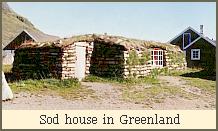
Sod house in GreenlandNorth America received further transfusions of northern European blood throughout the 18th and 19th centuries. The Dutch and the Germans were already well-represented in the original colonies. In the later 19th century Swedes and Norwegians spread across the northern plains of the United States and Canada, bringing with them an ability to withstand the harsh winters and an additional dose of the spirit of the North. The same folk who settled Greenland and Iceland came centuries later to homestead the frozen lake country of Minnesota and North Dakota.
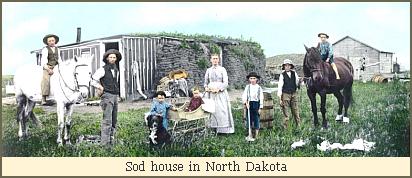
Sod house North Dakota

This, then, is the complex American character, which is the largest facet of what is now known as the Anglosphere. But it is no more English than it is Irish or Scottish or Danish or Welsh. It is the character of the Men of the North, and is best represented by the Minutemen, the freeborn citizens who took up arms in 1776 to retake their ancient liberties.

What was originally a racial characteristic had long become a cultural one. It remains open to anyone who cares to accept the rules and join the game. After all, Thomas Sowell has shown that the descendents of African slaves adopted Southern redneck culture, and not just its positive aspects. Prior to the Multicultural Age the main attraction of our country was that anyone who came here, obeyed the law, and took the oath became an American.
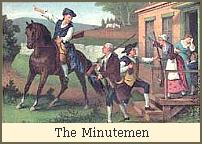
The MinutemenThe Pharaonic model was neither understood nor welcomed here. We are the descendents of those Paleolithic hunters, and when the Minutemen rose up in self-defense, they were, in effect, confronting another mastodon with their flint-tipped spears. They were a voluntary and self-organized group, taking collective action by common consent to serve a common purpose.

We are not so many generations removed from the Men of the North; their spirit can still be revived. The welfare state is only a recent graft onto the tree of Liberty. It is as ephemeral as was the Norman yoke on the shoulders of English yeomen.

The Men of the North faced lethal reality with nothing more than their courage, their wits, and a willingness to co-operate with one another. We will need to do the same again.

A new mastodon is looming in the glacial mist. We can only hope that the art of knapping flint is not completely forgotten.


This essay was inspired by a comment from Archonix on one of Dymphna’s posts:

Rather than Europe in general, America more resembles pre-Norman England and Scandinavia — especially… Denmark. Funny, that. The Nordic legal system rested first on the primacy of the individual’s rights and responsibilities and went from there. And even post-Norman England retained most of that individualism, despite the imposition of Frankish bureaucracy — i.e. the Domesday Book. Because those Normans, as you may know, were originally from somewhere around southern Sweden or Norway.

In trying to define Western Civilization, I have often asked the question, “Who are we?” This is part of the answer.

When we Americans look at Denmark — and the response of the Danes to the aggressive provocation of the Mohammed Cartoon Crisis — we are looking in a mirror. We would be well-advised to emulate our Viking cousins when our own turn comes.

Denmark matters.
Tuesday, November 10, 2009

How Muslim Piracy Changed the World

Last month we published an excerpt from “Islam and the Dark Age of Byzantium” by John J. O’Neill. Mr. O’Neill returns with an essay about the ways in which Muslim piracy and brigandage influenced the Christian world far beyond the bounds of the Mediterranean and the Middle East.

During the course of the last five years, in my capacity as a collator of information about the Muslim world, I have come to regard Islam as an incarnation of the Destroyer. For every Arab astrolabe or treatise on geometry, there have been a thousand — or a hundred thousand — incidents of murder, pillage, torture, slavery, and wanton destruction of anything sublime and beautiful that originated outside of Islam.

Mr. O’Neill’s essay makes me realize how far afield Islam’s baleful influence has in fact extended. The legacy of the Prophet reaches from the causeway at Tenochtitlan to the temples of Kerala and the beaches of Bali, from the coast of Iceland to the shores of Zanzibar.


How Muslim Piracy Changed the World
by John J. O’Neill


In my recently-published book, Holy Warriors: Islam and the Demise of Classical Civilization, I argued that it was the coming of Islam, in the mid-seventh century, which effectively brought the Classical Civilization of Greece and Rome to an end and initiated the Middle Ages. There I showed that the Muslim conquest of the Middle East and North Africa, from the 630s onwards, closed those areas to trade from Europe; and the consequent impoverishment of the latter led to the decline of the urban centers which had been the powerhouses of Classical culture.

But it was not war alone that brought this about. After all, from the beginning of history, empires had come and gone around the shores of the Middle Sea, yet trade and economic life had continued. With the rise of Islam, it is clear, this did not happen. All trade between the Christian West (and Christian East) and the newly-Islamic East was terminated, definitively. We know this for certain by the data brought forth by Henri Pirenne and others. Why did it happen? Did the Caliphs forbid merchants to trade with infidels?

The truth is far worse.

Barbary PiratesOne of the fundamentals of the Islamic faith was the acceptability, even the duty, of Muslims to wage war against the infidel. Islam divided the world into two starkly opposing camps: that of Islam, the Dar al-Islam, and that of the unbelievers, which was known as the Dar al-Harb. But Dar al-Harb literally means “House of War”. Jihad or Holy War, as we have seen, was a fundamental duty of all Muslim rulers. Truces were allowed, but never a lasting peace. (See eg. Koran, 8: 40 and 9: 124). In the words of medieval historian Robert Irwin, “Since the jihad [was] … a state of permanent war, it [excluded] … the possibility of true peace, but it [did] … allow for provisional truces in accordance with the requirements of the political situation.” (Robert Irwin, “Islam and the Crusades: 1096-1699,” in Jonathan Riley-Smith (ed.) The Oxford History of the Crusades (Oxford, 1995) pp. 237). Also, “Muslim religious law could not countenance the formal conclusion of any sort of permanent peace with the infidel.” (Ibid.) In such circumstances, it is evident that, when the Islamic forces were in a position of strength, almost all contact between them and the outside world was warlike. And this was not war as is waged between two kingdoms, empires, or dynasties: This was total war, war that did not distinguish between combatants and non-combatants, and war that did not end. In this spirit, Islamic generals launched attack after attack against the southern shores of Europe during the seventh and eighth centuries; and these “official” actions were supplemented by hundreds, even thousands, of lesser raids, carried out by minor Muslim commanders and even by private individuals: For it was considered legitimate that the Muslim faithful should live off the infidel world. Whatever spoils could be taken, were divinely sanctioned.

Thus the coming of Islam signaled a wave of banditry and piracy in the Mediterranean such as had not been seen since before the second century BC, when such activities were severely curtailed by Roman naval power. Indeed, it seems that this new Islamic piracy surpassed in scope and destructiveness anything that had come before. We could mention here, from the seventh and eighth centuries and later, quite literally hundreds of accounts of attacks in Greece, Italy, southern France, Spain, Sicily, Sardinia, and Corsica, carried out by Muslim freebooters and slave-traders. Neither Eastern nor Western Christendom was safe, and Crete, for a long time, was the centre of the Mediterranean slave-trade; a dubious honor she retained till the island was retaken by the Byzantine Emperor Nicephorus II Phocas around 956. (See John Julius Norwich, The Middle Sea, p. 94) These cut-throats, it seems, did not confine themselves to capturing towns and their inhabitants, but plundered churches and monasteries too, putting their occupants to the sword or selling them into slavery. The entire Mediterranean, east and west, was now off-limits for trade and, “In the Occident … the coast of the Gulf of Lyons and the Riviera to the mouth of the Tiber, ravaged by war and the [Muslim] pirates, whom the Christians, having no fleet, were powerless to resist, was now merely a solitude and a prey to piracy. The ports and the cities were deserted. The link with the Orient was severed, and there was no communication with the Saracen coasts. There was nothing but death.” (Henri Pirenne, Mohammed and Charlemagne, p. 184)
- - - - - - - - -
The history of Muslim freebooting in the Mediterranean has never, I feel, been properly written. This is a great omission, as its effect upon history and the development of western civilization was profound, even decisive: For it was Muslim piracy, much more than regular warlike activity, that brought classical civilization in the west to an end. This was the force which terminated, once and for all, the cultural and economic contacts between east and west, and which gave birth, as Pirenne rightly saw, to what we now call the Middle Ages. Of the situation at the time, we might agree with the judgment of a Dutch economic historian who wrote: “One could say, in modern parlance, that an iron curtain now divided the Mediterranean, whose littoral had once formed an economic whole.” (B. H. Slicher Van Bath, )

The pillaging and slave-raiding which began in the seventh century never really came to an end. It continued incessantly, with varying degrees of intensity, until the beginning of the nineteenth century, and was to have a devastating effect not only on trade, but on the culture of every society bordering the Mediterranean, and eventually on the whole of European civilization. Both East and West were devastated. Nor was the pillaging confined to the sea and coastal regions. From the mid-seventh century onwards Arab forces struck at Constantinople both by sea and by land, through the Middle of Asia Minor. In the latter case “not once or twice,” as Cyril Mango noted, “but practically every year … for nearly two centuries.” (Cyril Mango, Byzantium, The Empire of New Rome, p. 25) The consequences of this prolonged process, he notes, “are easy to imagine: much of Asia Minor was devastated and depopulated almost beyond repair.” And we should not imagine, as some authors do, that the revival of Europe during the eleventh century and the advance through the Mediterranean of fleets of Crusaders brought Muslim piracy — at least temporarily — to an end. This was emphatically not the case. Large, heavily armed fleets might move safely through the Mediterranean, but it was very different for merchant vessels. These, travelling alone, or in small and lightly-defended groups, were never safe. The Mediterranean remained a very dangerous place for all merchant shipping until the early nineteenth century!

The effects of this incessant pillaging upon the societies of southern Europe, those on the front line of this unofficial and interminable war, are not too difficult to imagine. Large areas of the coastlands of Mediterranean Europe became uninhabited and uninhabitable. The only analogy that springs to mind is to imagine the impact upon Northern Europe if the Viking raids had lasted a thousand years! Those communities which did survive, especially in the most vulnerable regions such as southern Italy, southern Greece, Sicily, Sardinia, Corsica, etc, were changed forever. The constant threat was to produce an almost paranoid suspicion of the outside world, plus a culture in which violence and vendetta were endemic.

A Barbary Corsair

Whilst the impact of Muslim piracy was thus decisive in the seventh century in terminating Classical Civilization, it was equally decisive in the fourteenth and fifteenth centuries in forcing Europeans out into the Atlantic in search of safer ways to travel to the Far East. With the blockade of the Mediterranean, Europeans were debarred from the rich spice trade with the Indies. For a brief period in the twelfth and thirteenth centuries the Mongols had opened trade to the Orient, at least by overland routes, and Europeans dreamed of a sea-route that would bypass the Muslim territories and the Muslim pirates in the Mediterranean. First, under Henry the Navigator, they sought a way round the southern tip of Africa, and later, under Columbus, they sought a quick route by sailing directly westwards. Columbus believed the earth to be much smaller than Eratosthenes had calculated, and imagined that China and the Indies lay roughly where we now know North America lies.

The Age of Discovery was therefore launched to find a way around the threat of Islamic piracy. Yet these journeys had another, more military, purpose in mind. In his representations to the Spanish King and Queen, Columbus made it clear that the discovery of a “short” route to China might open the possibility of an alliance against Islam. The main purpose of the projected expedition was, in the words of Louis Bertrand, “to take Islam in the rear, and to effect an alliance with the Great Khan — a mythical personage who was believed to be the sovereign of all that region, and favourable to the Christian religion …” (Louis Bertrand, The History of Spain, p. 163) Bertrand was very insistent on this point, which he emphasized in half a dozen pages. The voyage of discovery was to begin a new phase, he says, in “the Crusade against the Moors which was to be continued by a new and surer route. It was by way of the Indies that Islam was to be dealt a mortal blow.” (Ibid.)

So certain was Bertrand of the connection between the exploits of the Conquistadores in the Americas and the war against Islam that he actually describes the conquest of America as the “last Crusade.”

The record of the Conquistadores in the New World needs no repetition here: It is one of cruelty and greed on a truly monumental scale. Yet the habits of the Spaniards here, habits which gave rise to the “Black Legend,” were learned at the school of the Caliphs. In Bertrand’s words: “Lust for gold, bloodthirsty rapacity, the feverish pursuit of hidden treasure, application of torture to the vanquished to wrest the secret of their hiding-places from them — all these barbarous proceedings and all these vices, which the conquistadores were to take to America, they learnt at the school of the caliphs, the emirs, and the Moorish kings.” (Ibid. p. 159)

Indeed all of the traits associated with the Spaniards, for which they have been roundly criticized by Anglo-Saxon historians, can be traced to the contact with Islam.

“The worst characteristic which the Spaniards acquired was the parasitism of the Arabs and the nomad Africans: the custom of living off one’s neighbour’s territory, the raid raised to the level of an institution, marauding and brigandage recognized as the sole means of existence for the man-at-arms. In the same way they went to win their bread in Moorish territory, so the Spaniards later went to win gold and territory in Mexico and Peru.

“They were to introduce there, too, the barbarous, summary practices of the Arabs: putting everything to fire and sword, cutting down fruit-trees, razing crops, devastating whole districts to starve out the enemy and bring them to terms; making slaves everywhere, condemning the population of the conquered countries to forced labour. All these detestable ways the conquistadores learnt from the Arabs.

“For several centuries slavery maintained itself in Christian Spain, as in the Islamic lands. Very certainly, also, it was to the Arabs that the Spaniards owed the intransigence of their fanaticism, the pretension to be, if not the chosen of God, at least the most Catholic nation of Christendom. Philip II, like Abd er Rahman or El Mansour, was Defender of the Faith.

“Finally, it was not without contagion that the Spaniards lived for centuries in contact with a race of men who crucified their enemies and gloried in piling up thousands of severed heads by way of trophies. The cruelty of the Arabs and the Berbers also founded a school in the Peninsula. The ferocity of the emirs and the caliphs who killed their brothers or their sons with their own hands was to be handed on to Pedro the Cruel and Henry of Trastamare, those stranglers under canvas, no better than common assassins.” (Ibid. p. 160)


Holy Warriors: Islam and the Demise of Classical Civilization is published by Felibri.

Saturday, December 26, 2009

Reconsidering Africa

In describing their interactions with Africa over the last two centuries, Europeans have veered between two extremes. At the one pole would be their original understanding of the African as an illiterate heathen savage, to be brought to civilization and Christianity by the beneficial efforts of the white man. At the other extreme is the modern vision of the European as the rapacious, greedy, evil exploiter of the noble and innocent African.

Through all the Eurocentric noise about Africa, it’s often hard to get a sense of what Africans really were (and are). Yet during the first half of the 19th century — after the exploration of the Dark Continent had begun, but before the “scramble for Africa” got underway in earnest — a number of Europeans who visited Africa attempted to record what they saw with accuracy and lucidity.

Take, for example, this description of the Bosjesmans (also known as Bushmen) by Sir John Barrow (1764-1848):

Bosjesman in ArmourAll the men had the cartilage of the nose bored, through which they wore a piece of wood or a porcupine’s quill. Whether they are considered as to their persons, their turn of mind, or way of life, the Bosjesmans are certainly a most extraordinary race of people. In their persons they are extremely diminutive. The tallest of the men measured only four feet nine inches, and the tallest woman four feet four inches…. [T]hey are known in the colony under the name of Cineeze, or Chinese Hottentots. Their bellies are uncommonly protuberant, and their backs hollow; but their limbs seem in general well turned and proportioned. Their activity is incredibly great. The klip-springing antelope can scarcely excel them in leaping from rock to rock; and they are said to be so swift, that, on rough ground, or up the sides of mountains, horsemen have no chance in keeping pace with them…. The Ethiopian soldiers, when called upon to defend themselves, or to face an enemy, stuck poisoned arrows with a fillet bound round the head, which, projecting like so many rays, formed a kind of crown. The Bosjesmans do exactly the same thing; and they place them in this manner for the double purpose of expeditious shooting, and of striking terror into the minds of their enemies…. Their bows are remarkably small; and, in the hands of any one but a Bosjesman, would be entirely useless. From the earliest infancy they accustom themselves to the use of the bow. All the little boys who came to us at the kraal carried their bows and small quivers of arrows. A complete quiver contains about seventy or eighty…. [Vol. 1, pp. 233-34, 239, 243]

The Bosjesmans resided mainly in that region of Africa controlled by the Dutch settlers, the Boers, who over the past fifty years or so have gained a reputation as the cruelest and most evil of the white exploiters of Africans.

But how justified is this version of the Boers? Our Flemish correspondent VH ran across an account of an anti-slavery law from the early 17th century instituted by the Boers to protect the Bosjesmans:
- - - - - - - - -
Quite a while ago I stumbled upon the text below in “Original Matters contained in Lieut.-Colonel Sutherland’s Memoir on the Kaffers, Hottentots, and Bosjesmans of South Africa” (Cape Town; Pike & Philip, MDCCCXLVII (1847); pp.53-54).

Although it was followed by the note: “But Hell is paved with good intentions,” it may well have been a remarkable law for the 17th century, and for the Dutch (Boer, which means “farmer”) colonizers/immigrants in the South African region.

The book is available online at Google Books:

It is quite evident that they (the Bosjesmans women and children) would have been at once declared slaves, and, indeed, placed thus under task-masters who were themselves living far beyond the control of the laws; it is a distinction without a difference. The following admirable Dutch law alone prevented, in all probability, the local government from declaring them to be slaves:— “The aborigines shall be undisturbed in their liberty, and never enslaved; they shall be governed, politically and civilly, as ourselves, and enjoy the same measures of justice. Good rules shall be made for teaching them, and especially their children, the truths of religion and the usages of civilized life; and care shall be taken to withdraw them from heathen customs, and from indolence, the mother of want, to the cultivation of the soil, and to such habits as their condition and capacity may bear,” — Dutch Law, A.D. 1636.

This excerpt is a reminder that the relationship between Europeans and their colonies was more nuanced than the postmodern anti-Orientalists would have us believe. Many — if not most — Europeans who ventured into the heart of darkness believed it was their Christian responsibility to treat the heathen with solicitousness and compassion. It was evident to them that God had created the colonial races as the childlike inferiors of the Europeans, and it was their duty as good Christians to act as wise stewards of their charges, aiding and protecting them as they brought them into the light.

We find it easy now to look back on such attitudes and sneer, but it’s important to remember that these were enlightened and progressive ideas of their day. The slave-traders who plied the coastal markets and bought up shiploads of human cargo were the brutal exploiters, but the farmers who settled the interior did so with the intention of doing what was right in the eyes of God.

And this law was enacted in 1636, almost two hundred years before William Wilberforce spearheaded the great movement to end the slave trade. Meanwhile, Muslim Arabs had been enslaving black Africans for nearly a thousand years prior to that time, and would continue doing so for another three centuries. Yet the first European settlers in southern Africa were the ones who passed a law forbidding slavery.

We all know the grim denouement of the story of European involvement in Africa, but it’s sometimes useful to look at events from the point of view of the people who were actually involved at the time, people who had no idea of the multicultural dystopia that would eventually develop out of the ruins of European colonialism.

Tuesday, December 09, 2008

First the Moroccans, Now the Somalis

We’ve written here a number of times about the issue of Somali refugees who have been resettled in the United States, particularly in the Minneapolis-St. Paul area. Other countries — notably Sweden and Norway — have experienced similar problems with Somali refugees, including endemic violence, gang behavior, rape, vandalism, and chronic unemployment.

In the Netherlands, the traditional “problem groups” are the Moroccans and the Turks. But there are Somali refugees in Holland, too, creating the same problems they have brought to other countries. By the government’s own admission, nine out of ten Somali men are unemployed, which is a sure recipe for disaster.

Below is the translation by our Flemish correspondent VH of an article from Trouw. VH included this prefatory note with his summary of the situation:

A decade or more ago there were a lot more Somalis in the Netherlands. Most of them left for the UK later, though. They were selling qat from the boot of their cars near the station in those days.

Dijsselbloem is a PvdA [Labour] representative, and might want to spread the attention from Moroccans to other immigrant groups. Labour went down in the polls a number of weeks ago, to the same level (of the slowly rising) PVV. That scared them off and since then they pretend to have a harder stand on immigrants, only to gain in the polls. If there ever were populists, they are the Socialists. This might be one of their attempts to re-attract runaway voters. Of course all Muslims and immigrants are susceptible to radicalization, as the Somali immigrants are. But the Moroccans (descendants of the slave traders and the colonizers of Spain) are a different piece of cake, and many of them are already radicalized, and the Moroccan government sees the Netherlands as one of their provinces already. The Turks (ex-Ottomans) have so far a more stealthy way of Islamizing the Netherlands: with the help of the Turkish Government and Mili Gorus they try to build Mosques and achieve important positions in the government.

And now his translation of the Trouw article:

After problem-Moroccans, there are now also problem-Somalis

“This group should be helped immediately”

Photo caption: In a basement in the south of Rotterdam a “qat-house” has been arranged. Local residents have already complained.

A small group of Somali youth are causing a concern. They risk to slide down and become the successors of Moroccan problem youth.

Their parents are not integrated, have other concerns, and are not involved in the education of their children. The school dropout rates among Somali youth is great.

PvdA [Labour] member of Parliament Jeroen Dijsselbloem is going to insist on a “tailored approach” to problem groups in the discussions on the integration budget for next year. He notices that the government [PvdA, CDA -Christian Democrats, CHU -Christian Reformed Union, leftist Christians] is making hardly any progress in recent years concerning those groups and wants politics “not to be color blind”. Dijsselbloem is not only concerned about the integration of large immigrant groups such as the Moroccans, Turks and Antilleans [from the Dutch colony in the Caribbean], but also about Somalis. “Nine out of ten Somali men are unemployed. The group has a lot of drug problems and their women are being disadvantaged.”
- - - - - - - - -
The Dutch General Intelligence and Security Service (AIVD) shares the concerns about young Somalis who suffer from problems such as drug addiction, homelessness, dropping out of school, and isolation in loneliness. According to the Security Service they are susceptible to radicalization.*

“Everywhere you read about problems with the large immigrant groups such as Moroccans, Turks and Antilleans. A small group like the Somalis is overlooked,” says Alexander Borst of the foundation of the Church’s Social Work (Kerkelijk Sociaal Werk, KSA) in Rotterdam — an organization for ideological social outreach.

There are around 20,000 Somalis in the Netherlands. “The first group that arrived here is poorly integrated and barely participates,” says Borst. “This warning is no panic-play. This group of Somalis really needs to be helped urgently. The problem is that they are barely organized and therefore difficult to reach. Being a nomadic people, they operate in clan-related connections.”

The Somali community includes relatively many divorced mothers, who are on their own to raise their children. Older Somali men in turn often suffer from loneliness and have problems with the psychedelic drug Qat. “In the intake we also see many Somali men with severe alcohol problems. This has implications for these families,” according to Borst.

Somali parents haven’t got into in the Dutch school system and show little complicity in the education of their children. There are parallels with the Moroccan community here. Borst: “With their adolescent children the school dropout rate is high. And we know what kind of trouble bored children sometimes cause. Many of those Somali youngsters join groups of troublesome Moroccans.”


Notes from VH:

* The AIVD information might be derived from their annual report. See the most recent report (pdf, in English).

The same article also appeared in other media under the title: “Somalis are the new Moroccans” (see for instance Allochtonenweblog).

Sunday, December 11, 2011

Permanent Guests

The following article by Necla Kelek was first published on October 29 in the Frankfurter Allgemeine Zeitung, and comes to us via Europe News. It has been translated by JLH, who includes this note:

It may be time to remind — or inform — your readers that the Turks were not brought to Germany by wicked slave traders. German ex-pats who found employment in German university departments in the USA contributed to the attitude here by including in some of their first- and second-year language books a chapter or so on the plight of the Turk who was at home neither among his indifferent German colleagues nor for a visit among alienated family and acquaintances.

And the translated article:

Guest Workers — The Art of Misunderstanding
by Necla Kelek

It was not Germany they saved; it was Turkey. Why the first Turkish guest workers came and why they were not victims.

“Every one of our brothers and sisters worked day and night here, to win hearts. They turned every bitterness to honey, they defied every difficulty.” President Tayyip Erdogan said that in 2008 in a speech to Turkish immigrants in Cologne. It was balsam for the souls of his listeners. They were only too glad to hear it.

Necla KelekGerman politicians, too, are inclined to define the history of worker immigration as one of Turkish victims and German guilt because of exploitation. But this version of history is a fairy tale.

In 1961, in response to the initiative and pressure from the Turkish government, the recruitment agreement was established between the Federal Republic of Germany and Turkey — as had already been done in 1955 with Italy and other countries. Actually, Turkish workers — both male and female — were not needed so urgently in Germany. But there were geopolitical reasons. The United States was pressing the Germans to support Turkey economically. In 1960 in Cuba Fidel Castro had thrown out the dictator Batista and the Americans. In Turkey too, the students and unions were in revolt. Global equilibrium seemed to be teetering out of balance.

Recruitment Agreement as Last Official Act

When the internal political situation became too hot for the Turkish military in 1960, it took power in a lightning strike, detained President Menderes, who had initiated democratic reforms, eased contacts with the Soviet Union, flirted with contacts with the United States, and promoted Islamization. No Western nation seriously protested the putsch.

NATO needed allies on the “southeast flank” of the socialist block, and militarily powerful Turkey was the historic partner. This was shown not long afterwards during the Cuban Crisis, in which Turkey played a significant role. The price exacted by the Turkish generals who supported NATO: a share in the economic rise of Europe.