Tuesday, September 06, 2005

Sheepdogs Driving the Bus

 
The blogosphere is reverberating with the drums echoing from Bill Whittle’s fine essay about the divisions of people into tribes. What follows is not exactly a summary; it’s closer to a synthesis of his ideas written for those of us with the attention span of your average Cub Scout. That being said (“that” meaning you should go read the real thing here), let’s look at Mr. Whittle’s fine images, beginning with the Pink People.

Whittle’s PP’s are typified by Hollywood types, though Pink is not confined just to Hollywood — it’s simply that there are more Pink People per square inch in Hollywood and its environs than there are anywhere else, except perhaps in Washington, D.C., a place for which Pink People also have an affinity…

When you Think Pink, consider Sean Penn in his rescue boat — a four person “rescue” boat which Mr. Penn fills with four people, one of whom is his personal photographer. A boat in which the plug had not been fastened so that there are many hilarious ( or hideous, depending on your sensibilities) pictures of Mr. Penn bailing the boat with a red plastic cup. Mr. Penn, Pink Person extraordinaire, was not out to rescue anyone. This was merely his trip to Iran translated to American. He was in New Orleans to appear to be rescuing someone. No doubt he left money there also, to show he was acting in good faith (since he does not act particularly well, acting in good faith may be all he has left in his small bag of tricks). Mr. Penn may even have left some of his good-faith money with the mayor, who is definitely a Pink Person — a Pink Person appearing as a mayor. This pink-to-pink transfer allows all the Pinks to feel good, and to a Pink, feeling good is the summum bonum.

Pink people wear rose-colored glasses. They prepare for the future by grabbing as much material wealth as possible and then looking down on others, whose actions in life may originate from different motivations. Pink people do well until they are called upon to act decisively for others in situations where they themselves may be at risk. This situation does not cause a change in color. They simply scream in place until a grey person eats them or rescues them.

The grey people? Here is where I synthesize Mr. Whittle’s comments. He describes this grey as the color of concrete. Where Pink People are soft, Grey People are hard, like the graphite in mechanical pencils. They are that way on purpose because they act purposefully, wherever they are.

Some of the Grey Guys are Good Guys and some aren’t. The first group of GG’s are the wolves, either those who are loners or those who run in packs. Some of the Grey Guys appear to be Good until push comes to shove and then they turn their coats and what you thought was a sheepdog, herding the rest of us, becomes a wolf, eating the rest of us. The sad misfortune of the Sheepdogs-turned-wolves in New Orleans — the police officers ‘captured’ on videotape breaking open display cases and looting stores — is that they cannot turn their coats back again. Once exposed, the wolf skin sticks tighter than mendacity does to Michael Moore. None of them may go home again because they helped demolish the place where they live and move and have their being. As the farmer says, not even an animal defecates where it eats. But those people did, ergo, they slipped below the level of animal to some sub-routine in the reptilian brain we all possess.

The Grey Guys who are sheepdogs are the ones we depend on when conditions get dicey. I don’t want one of the Pink People in charge. I don’t want to have to abide by the edicts — or lack of them — emanating (or not emanating) from the likes of Pink People such as the governor of Louisiana. With leadership like that, I am likely to drown, sometimes with another person’s foot on my head. With leadership like that, the Good Grey Guys, the sheepdogs, have to revert to their own good sense. They have to take the law into their own hands because the law is three feet under the swirling waters and the sludge and the Pinkies are crying about how awful everything is. One of the favorite rejoinders of the Pink People in tough times? “No fair!” You can see many examples of this behavior in the Exodus of the Jews from Egypt. Moses was a sheepdog but he was forced to lead the sheep despite themselves.

A good example of a sheepdog, a Good Grey Guy, is Haley Barbour, governor of Mississippi. If there is a more snake-bitten state than ol’ Miss, I’m hard put to know what it is. There is one teaching hospital in the whole state. “Dirt poor” must have been coined so that it could ride in front of Mississippi. Currently, the state’s median income is twenty-five per cent lower than the national average. But the dirt and the poor presented many opportunities for the Good Grey Guys to come loping in to do the dirty work of clean-up. And they did, led by their governor and by the local officials and municipal police who worked to rescue people and restore order. Was it perfect? No. But Mississippi shone where Louisiana went dark. Mississippi’s African American folks are no better off than Louisiana’s; they just have a larger mass of Good Grey Guys, of both races.

Wolves prey on those in duress; Good Grey Guys prey on the wolves. These two are cut from the same cloth, really: tough, strategy-minded, ready for a fight. It’s the motivation that drives them which makes the difference. The Bad Guys are out for the same thing the Pink People are. It’s all about Me and Mine and who gets to divide the spoils. Pinkies and the Wolves are opportunists in the midst of calamity. The sheepdogs, the Good Grey Guys, are driven to protect us from the wolves. They figure if we’re taken in by the Pink People’s lives of trivial pursuits, that’s our look-out. Theirs is to protect us from the Wolves so we can continue listening to the Bloviating Pinkies. Meanwhile, just get out of the way.
Renegade Bus
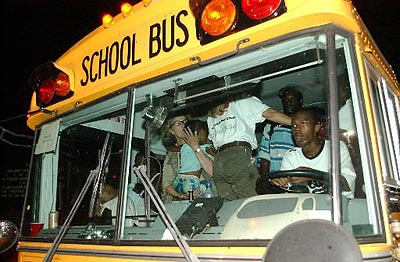
Which brings us to a young sheepdog, a very young Grey Guy who now has his credentials in hand. It’s Jabbar Gibson, of course. The young man — I’ve seen reports giving ranges in his age from fourteen to twenty years old — commandeered a bus and drove for thirteen hours to Houston. A novice who’d never driven a bus before drove non-stop, delaying only long enough to pick up strangers, to buy diapers, and to get more gasoline with money scrounged from passengers.

To underline the Grey Guy demeanor of this young man, he did not find the bus just sitting on the flooded street. He climbed the fence of a school and got the bus going. He opened the gate and he proceeded, with eight others, to get out of Dodge. This is a kid without a driver’s license (horrors!) who doesn’t have a car of his own. But those technicalities didn’t stop him. Nor did the possible fact that he’s probably never been out of New Orleans before. He started with young people —his friends and neighbors, no doubt — and slowly filled the bus with a motley assortment of strangers standing by the side of the road begging for help. One woman was carrying an eight-day old baby. There were old people. There were families. The de facto leader (another sheepdog), Miltralyn Isaac, helped Jabbar Gibson with stealing the bus. After that, except for having to scrounge for money for gas and diapers it was all down hill and green lights. No one had anything to eat, but at least they were out of New Orleans. At least they were alive.

If you are like me, you may be wondering why none of the gas stations where they stopped were curious about their plight, why no one offered food or extra money for gas. Were the passengers and the driver afraid to tell of their situation, knowing they were on a stolen bus headed over to a place that promised refuge and seemed safer than saying anything? When the movie comes out, it will be interesting to see if they cover that angle. Fear can keep us from asking for help.

Here’s my advice: take Mr. Whittle’s essay and hold it up against your own life. Use it as a mirror. Are you a Pink Person? Then “Let’s roll” will never pass your lips; it will never even enter your mind. Are you a grey wolf? Then you’re already considering ways to make money from this disaster. Perhaps you already have. Are you a sheepdog? Then you’re beginning to contemplate the things you need to do to make your family and neighbors safer in the event of disaster. And if you’re a true-grey sheepdog, you know there are no innocent bystanders, there are no safe “it-couldn’t-happen-here” places.

Disaster can happen anywhere. Unlike Mr. Whittle, I have never rescued anyone. But I’ve been in a restaurant I helped run, knee deep in flood waters and watching a Pacman machine floating out the door. I’ve been stranded for ten days in a snow and ice aftermath with not enough food and no diapers for my baby. I’ve known the rage of floodwaters, I’ve known the aimlessness of the swirling aftermath. I’ve seen the levee built and I’ve stocked up on food…the diapers are no longer necessary.

Mr. Whittle doesn’t say so, but the underlying message in his story is that we must become more self-reliant. I’m looking into that. Shortly I will know how much solar panels cost and what the best way to store dried food is. Guess I’m going to have to bite the bullet and learn how to shoot that nine millimeter I vowed to learn to master as a New Year’s resolution a few years back.

Time to ready the ground next month to put some tomatoes and beans and what-not where the zinnias used to grow. Time to prune the apple trees and spray them and take better care of what we have. Living on a ridge above the river will save me and mine from the fate of New Orleans. But the grey wolves are everywhere.

We’ll be ready.

Monday, September 05, 2005

Mayhem In Ephraim

I Could Scream: Examining the plight of women under Islam
Taiba is a Christian village east of Ramallah.The fifteen hundred people who live there are either Roman Catholic, Greek Orthodox, or Greek Catholic. Despite factional divisions among Christians elswhere, those in Taiba obviously have banded together for safety. Unfortunately, their coming together here didn’t protect them from the Muslims who surround them. Last Saturday night, when the Muslims struck, Taiba might as well have been located on the moon.

What triggered the event? Oh, the usual: an Islamic rage-reaction meltdown to the idea of their women’s sexuality. These people really do bear some behavioral resemblance to yellow jackets. Unfortunately, one cannot simply take medicine to counteract their poisonous sting.

The Christian Arab village of TaibaA thirty-year-old Muslim woman from the nearby village of Deir Jarir was discovered by her family to have been romantically involved with a Christian man from Taiba. Their solution to this treason was to make her drink a dose of lethal poison and then bury her body. When the Palestinian authorities began an investigation of this crime, including the exhumation of the victim's body, the result was a rampage by the Muslim men of Deir Jarir against the Christian village of Taiba.

Note the sequence here:
1.   the Muslim family discovers the woman’s behavior;
2.   the only possible recourse to their perceived shame is to murder their sister/daughter/cousin, etc. and to cover up the act;
3.   when the Palestinian authorities decide to investigate the matter, it becomes a village-wide response of rage. Now that the woman’s harlotry is public, what is there left to do
4.   but to mount an assault on the village of the Christian man with whom she was consorting?

No doubt the consensus of the people of Deir Jarir was that it was the fault of both the harlot and the PA — the first with her behavior and the second in their refusal to mind their own business. Now that events are public, honor must be restored.

So they set off, about five hundred men strong, and proceeded to ransack Taiba, looking for the woman’s consort. But Mr. Khoury had long fled his village so there was nothing left to do but bellow “Allahu akbar” (loosely translated, it’s an Arabic phrase meaning “kill anything that moves and steal whatever is not nailed down”) while pouring gasoline on and burning whatever had not been stolen or broken. All of which are honorable Islamic practices when calling on the neighbors. Personally, I much prefer the early Christian custom of taking two witnesses to reprimand a wrong-doer. But that's just my limited, Islamophobic view.

What, you ask, did this group of village elders do precisely?
     More than 500 Muslim men, chanting Allahu akbar [God is great], attacked us at night,’ said a Taiba resident, according to Jerusalem Post. ‘They poured kerosene on many buildings and set them on fire.Many of the attackers broke into houses and stole furniture, jewellery and electrical appliances.’
A statue of the Virgin Mary was destroyed. At least 16 houses were burnt down. The streets of Taiba were empty on Sunday as all residents stayed indoors while PA policemen roamed the streets. It was like a war, they arrived in groups, and many of them were holding clubs,’ said another resident.
The Palestinian Authorities took their time arriving. Is this a surprise? By the time they got there, cars had been torched, sixteen houses burned, and the whole village terrorized. The PA did manage to prevent the mob from harming the Khoury Beer Factory. Evidently, Taiba beer is famous in the area. Not partaken of by the Muslims, of course, since the Koran forbids it and these are Allah-fearing men.

The PA had an interesting excuse:
     Col. Tayseer Mansour, commander of the PA police in the Ramallah area, said his men arrived late because of the need to coordinate their movements with the IDF. "The delay resulted in the torching of a number of houses and cars in the village," he said.
As Wretchard at Belmont Club often says, Speculation Alert: The Jerusalem Post does not report whether or not it contacted the IDF to ask if this was the case, that movements needed to be “coordinated” with them, or if this was merely a delaying tactic of the PA to allow the marauders to have their fun first. It would be most interesting to know if the IDF has a policy of holding off to allow “the Arabs” handle their own conflicts — both villages are Arabic, after all — or if there was some other machination at play.

In a nice, ironic touch, it is claimed that Tabia used to be known as Ephraim:
     According to some accounts, Salah a-Din, who led the war against the Crusaders, was responsible for the name change. He is said to have found the villagers there to be nice and kind – in Arabic, taybeen – and the name stuck, to become Taiba.
Ephraim is the village where Jesus reputedly retreated before he began his journey into Jerusalem to be crucified.


Hat tip: Little Green Footballs

The Bloody Finger of Al-Reuters Points Again

 
By now, most blog readers have seen the famous “news” “reportage” by Reuters.

Warning: the blatant Bush-bashing in the first sentence of the story could be bad for your blood pressure if you’re at all sensitive to journalists’ standards — especially the rule that prohibits editorializing in news stories, the rule that says a good journalist saves the snarky comments for analysis rather than “reporting.”

This is by no means the worst of the lot, but it contains the essential ingredients for a recipe of reporter-as-useful-idiot that it ought to be saved and served up in Journalism 101 at, say, Columbia’s school of journalism, that bastion from which steely-eyed, objective “journalists” are extruded every year.

     New Orleans collects dead as officials dodge blame
By Mark Egan
NEW ORLEANS (Reuters) — New Orleans began the gruesome task of collecting its thousands of dead on Sunday as the Bush administration tried to save face after its botched rescue plans left the city at the mercy of Hurricane Katrina.
You don’t need to be told how egregious this is. But thanks to Jeff at Geopolitical Review, we now have a contact page for Al-Reuters. You can email the editors if you like. I suggest that you do so, and for this reason: complaining about something without addressing the complaint is not good for your health or for the commonweal.

Contact ReutersBefore you send your email to Reuters, I suggest you read the whole story, linked above. The writer, Mark Egan, goes on to “report” that Donald Rumsfeld toured the scene and shook hands with the doctors and not the victims. As I mentioned in my email and in the post here, he would have been unwise to come into physical contact with anyone who has been exposed to the contaminated and extremely poisonous cesspool of Katrina’s aftermath.

Egan doesn’t mention that even the reporters who were immersed in the “toxic gumbo” are also at risk. Perhaps he doesn’t even know — which, if that is the case, simply underlines his ignorance and questions his credentials for reporting on this mess.

However, Mr. Egan does manages a swipe at Condoleezza Rice by saying this:
    Rice was slammed by critics on the Internet after she attended a New York performance of the Monty Python musical “Spamalot” on Wednesday, a day after New Orleans flooded.
Notice that he doesn’t say who these critics were, nor does he cite his source. Nor does he say why the activities of the Secretary of State are germane to policy re the Katrina clean-up.

So this is journalism, huh? This is professional? This has integrity? Scurrilous, that’s what it is. No wonder that organization has been called al-Reuters. In the interests of protecting our country, Gates of Vienna is doing its small part by posting a permanent link to Reuters’ contact page. This is not going to go away until the useful idiots understand what they are doing.

Some teacher ought to make Mark Egan sit down and write a hundred times:

I will learn the difference between reporting and opinion.

Make that a thousand times. No… make it a life-long penance in remorse for attempting to damage the commonweal. In the old days, when journalism had standards, he would have been contemned and his story would have been spiked. But those days are over and the days of the useful idiots are here.

Don’t let them get away with it.

After the Deluge, the Plague Descends

 
Katrina's suffering is only just beginning. Even those who have gotten free are still in danger. So are those who followed events in New Orleans and filed their reports as they sloshed through contaminated streets and neighborhoods. Not only are the evacuees likely to be ill, they could well infect those who care for them, thus creating health crises in the refuge cities to which they have gone.

There are three groups under consideration.

The primary victims, first:
    ''We have the opportunity for things we haven't seen in many years -- cholera, typhoid, tetanus . . . malaria," said Dr. Marshall Bouldin IV, director of diabetes and metabolism at the University of Mississippi Medical Center in Jackson, the state's only major teaching hospital. ''We haven't seen health conditions like these in 50 years. . . . People are crowded together and they're wading through sewage."
That’s what’s in store for those who were in the malestrom, and may be still there. But what about the others, the ones who were finally evacuated in spite of the city’s initial ineptitude? They, too, are at risk of illness and death:
     That is why every effort should be made to prevent the evacuees from fanning out individually across the country until they have been given a battery of medical tests.
… every city and town now offering to shelter evacuees needs to air warnings on TV/radio to the effect that anyone who was in New Orleans during the flooding should immediately go to [X] clinic or X hospital for free medical testing. The warnings should be worded in the most urgent terms and accompanied by a toll free number to call.
This, Pundita urges, is the most important reason for keeping the New Orleans flood evacuees together: they need to be screened and to be treated for life-threatening illnesses. This includes the reporters who were there following the events.
     In addition to risk of exposure to hepatitis and cholera, anyone who came in contact with the floodwaters could be suffering from cellulitis and sepsis, not to mention rashes of all kinds. And there is also the risk of heavy metal poisoning from toxins absorbed through the skin or via cuts directly into the bloodstream.
At this moment and at all costs the victims of Katrina need medical treatment (for exposure, dehydration, etc.) and medical tests almost before they need food.
I add that the need for medical tests extends to all who came in close contact with the hurricane victims after the flooding began. This advice extends to television film crews and press reporters.
And third are the helpers, those who have taken evacuees into their cities, their shelters, their homes. They are also at risk for contagion from the diseases the evacuees brought with them from New Orleans.
     According to health experts, never before in the US have so many highly toxic chemicals and putrifying bodies been concentrated and trapped in a small area of flooding -- from which the living have had no escape for days.
And then, when they finally do flee, scrambling over the dead bodies of their fellow citizens, they have not escaped at all. Disease trails after them like some demented demon, calling their names, adding to the list those who help them and, most ironically, those who came only to report, who thought they weren't "involved."

After the deluge, the plague.

Saturday, September 03, 2005

Potemkin Village

 
The last five days of horror in New Orleans and southern Mississippi have shown that the renowned infrastructure of America is not all that it should be. The jihadist zealots of Al Qaeda (not to mention the Chinese military) must be observing with great interest the events in Louisiana, noticing the logistical choke points of the American economy and how easy they are to take out.

One can imagine the conversation around the big table during the Great Jihad Seminar in the Dar-al-Islam Conference Room of the Damascus Sheraton (loosely translated from the Arabic):
Mahmud:I see an opportunity here — how about it, people? Gimme some ideas…
Hassan:Well, if a hurricane can take out 25% of their refinery capacity, how about a suitcase nuke in Houston? My boys have a couple of ’em, and I’ve got the shaheeds to deliver them. Just give me the OK —
Walid:Let’s think outside the box here. How much of their meat supply passes through Chicago? And how much botulinum can we deploy there?
Mahmud:I’ll get my Brooklyn think tank to crunch the numbers for us…
Personal observation suggests how easy it would be to co-ordinate a few small explosions at selected pylons on several of the major northeastern high-tension power lines, thereby binging down a large part of the grid indefinitely. There are large tank farms for natural gas pipelines here in Central Virginia that would be easy to sabotage; after all, until the alert level rises to “orange”, they don’t even have coverage by the county deputies.

You can be sure that anything we think of here has already been thought of by our enemies in Al Qaeda, and elaborated, and planned out, and trained for. Our infrastructure is vulnerable, and it’s easy for our enemies to see that. We are the most powerful nation that has ever existed, but we are brittle, and Hurricane Katrina only serves to remind us of this fact.

*   *   *   *   *   *   *   *   *   *   *   *   *   *   *

Wikipedia offers the following definition of “Potemkin Villages”:
    Potemkin villages were, purportedly, fake settlements erected at the direction of Russian minister Grigori Aleksandrovich Potemkin to fool Empress Catherine II during her visit to Crimea in 1787. Conventional wisdom has it that Potemkin, who led the Crimean military campaign, had hollow facades of villages constructed along the desolate banks of the Dnieper river in order to impress the monarch and her travel party with the value of her new conquests, thus enhancing his standing in the empress's eyes.
The term is now widely used to describe elaborate and superficial constructions designed to pass official inspection, but lacking any real substance (as an ironic footnote, Potemkin’s villages as described above never really existed; they were an urban legend arising out of malicious gossip circulated by his political enemies).

If one wanted to describe the protective structures and emergency preparations in New Orleans and the Mississippi Delta region, “Potemkin Village” would certainly be the preferred term. Corrupt government, huge bureaucracies jostling to get their snouts into the federal trough — write the grant, get the money, repay the favors, reward your relatives — but keep the city looking good, keep the casinos open and the tourists coming in, keep the pipelines open and the barges moving. And the levees? Well, they’ve worked all right so far…

All across the country are aging bridges, deteriorating highways, decaying cities, and an antiquated power grid. Additional refining capacity can’t be built because it would be Bad For The Environment. Nuclear power is a no-no because of Demon Radiation. New roads are bad because they produce Evil Urban Sprawl. No swamp can be drained because of the Lesser Crested Loon. And everything depends on the Federal Government, the be-all and end-all, which is more powerful than God, which causes the rain to fall and the sun to shine, which is simultaneously the Protector and Nemesis of every man, woman, and child in the country, if not the whole world. Remember the Tenth Postulate of PC: “There are no acts of God; there are only acts of Government.”

This whole PC façade can only be propped up as long as the gatekeepers of the culture maintain the fictions. The success of the trompe l’œil depends on control of the flow of information. The mainstream media have up until now sutained the illusion that the PC village is one of attractive cottages, laughing children, and gamboling lambs, when in fact the brightly painted flats barely conceal the rude hovels and scabrous churls of the real village.

*   *   *   *   *   *   *   *   *   *   *   *   *   *   *

All this is in the process of change now. In a recent post called Industry, Redundancy, and Coping with Hurricane Katrina, Indus Valley Rising considered the nasty problems brought to light by Hurricane Katrina:
     It looks like fully industrialized societies may not be much of an improvement over societies that have not fully industrialized. In engineering (mechanical, software, etc.), when critical services that other system services depend on are concentrated in a single component or single center or operation, if that component or service fails the rest of the system goes down with it. That is called a “single point of failure.” Systems that have multiple failover mechanisms and redundant components are, however, considered more reliable because if one or more components go down, then the other redundant components for a time can assume the extra load. The system is strained, but it doesn’t go down. The cost of redundancy is high, but the cost of system failure is higher — even if it rarely happens. Like any other system that depends on highly specialized components but lacks redundancy, a highly industrialized society is similarly fragile because critical services become concentrated with a small number of people or agencies. If small but important social components fail on account of sabotage or disaster, the effect on the rest of society can be disproportionately catastrophic.
America, which is known as “the bread basket of the world,” has an especially vulnerable food supply. The seeming benefit of the industrialized food supply is that it allows fewer people to produce considerably more food. America produces so much food that to keep food prices high enough, the government has to offer subsidies to farmers to not grow food or just dump grains in the ocean. The down-side of America’s industrialized food supply is that, because food production is concentrated in the hands of a few (and we aren’t talking of storage systems that largely depend on the availability of transportation and electricity), the system has little scope for failover. This is true of many other essential components of society, but the food supply is perhaps the most obvious failure-prone component.
The recent disaster caused by Hurricane Katrina has highlighted this fragility in the American social system…
The environment, the economy, and the geopolitical situation are all changing, and with these changes the kind of society we build may affect our future chances of survival. If means of production, especially that of food, is a critical component of any social system, which will be the better long-term social strategy to implement:
  • globalization with its potential for higher efficiency and higher profits but increased dependency on services and products from foreign lands, or
  • localized production that is redundant and therefore more robust but less efficient and less profitable?
A localized means of production might be better suited to withstanding environmental threats like the Hurricane Katrina disaster or, more increasingly, disasters that could be wreaked by foreign enemies. These are things for which we shouldn’t be caught unprepared. Scaling down American commercial farm enterprises and encouraging small farmers who relied less on industrialized means of farming could be in the interest of America’s national security. Right now the chemical industry, the machinery industry, and food production are all tightly coupled. Loosening the couplings between these subsystems, which means making them less interdependent, would make for a more robust social system that could better withstand a catastrophe.
Krishna Kirti has drawn attention to an important strategic issue here. But the solution — relying on large numbers of smaller production components in a loosely-linked network — need not require a retreat down the technological ladder. As I remarked in the comments on his post,
     I don’t think that small-scale and redundant farming and industry necessarily means primitive operations only. The high-tech revolution is just beginning to impact the economy at all levels, and one of the coming trends will be the efficient miniaturization of enterprise.
With efficient use of information technology, the “economy of scale” rule will no longer be as significant as it used to be. Given the right equipment and software, an internet connection, and a robust power supply, small farms and manufacturing should be able to compete effectively with larger enterprises.
All this is predicated, of course, on their willingness to use modern methods (pesticides, fertilizer, etc.).
Think of the innovation that has been going on constantly in the military: small dispersed munitions controlled by computers; jury-rigged networks of laptops used by technically savvy soldiers in moving humvees to track the enemy and share intelligence; tiny intelligent sensor devices scattered over the battlefield, each having its own IP address and each monitoring events around it…

The information revolution is only just beginning, and its effects will be staggering. America has the natural advantage in this field, since the new paradigm requires non-hierarchical decentralized network structures, autonomous actors, and the ability to innovate. In other words: “fast, cheap and out of control,” according the meme invented by the MIT robot scientist Rodney Brooks.

How many more 9-11s or Hurricane Katrinas will occur before we get serious about reorganizing the general infrastructure in America?

A large part of the solution will be to recognize that a large part of the problem is the federal government.

And ideally we would reach a point where the only strategic failure to be feared would be the collapse of the internet.

Friday, September 02, 2005

Katrina Relief

FloydBusters
The unimaginable horror in New Orleans continues. To contribute to relief efforts, go to Glenn Reynolds at Instapundit or Charles Johnson at Little Green Footballs.

We are advising a visit to these sites' relief posts here and here. Mr. Reynolds is keeping his at the top of his blog. In it you will find recommended charities, links for donations, and suggestions for other ways to help.

Dymphna has her own relief ideas here.

Fate Has Handed You Another Chance. Speak Up, Sir.

 
UPDATE: Thank you, President Clinton, for putting a muzzle on the press. Fate handed you the ball and you not only ran with it, you scored a touchdown. Right now the score stands at Integrity 7, MSM 0.

As ever, you were eloquently persuasive. Best of all, you shut up a reporter. For that feat alone, a medal should be struck. Bush '41 has found himself a great guard dog in you.

Eventually, you'll have to go back to trying to get Hillary elected -- a promise is a promise, after all -- but right now in the thick of it, you took care of business. CNN will be more careful about its assumptions in the future.

Gracias plena, sir. You are some quarterback.

And thanks to Captain's Quarters, whose link it is above. The hat is gratefully tipped to The Anchoress for her heads-up.


With little further ado, here is the word regarding policies and handouts for the US Corps of Engineers in New Orleans during the Clinton administration. Straight from the horse’s mouth, in this case Sidney Blumenthal via The New Orleans Times-Picayune (hat tip: EU Rota):
    
February 17, 1995
An Army Corps of Engineers “hit list” of recommended budget cuts would eliminate new flood-control programs in some of the nation’s most flood-prone spots - where recent disasters have left thousands homeless and cost the federal government millions in emergency aid.
Clinton administration officials argue that the flood-control efforts are local projects, not national, and should be paid for by local taxes.
Nationwide, the administration proposes cutting 98 new projects in 35 states and Puerto Rico, for an estimated savings of $29 million in 1996.
Corps officials freely conceded the cuts, which represent only a small portion of savings the corps ultimately must make, may be penny-wise and pound-foolish. But they said they were forced to eliminate some services the corps has historically provided to taxpayers to meet the administration’s budget-cutting goals.
June 23, 1995
A hurricane project, approved and financed since 1965, to protect more than 140,000 West Bank residents east of the Harvey Canal is in jeopardy.
The Clinton administration is holding back a Corps of Engineers report recommending that the $120 million project proceed. Unless that report is forwarded to the Office of Management and Budget, Congress cannot authorize money for the project, U.S. Rep. William Jefferson’s office said Thursday.
On June 9, John Zirschky, the acting assistant secretary of the Army and the official who refused to forward the report, sent a memo to the corps, saying the recommendation for the project “is not consistent with the policies and budget priorities reflected in the President’s Fiscal Year 1996 budget. Accordingly, I will not forward the report to the Office of Management and Budget for clearance.”
July 26, 1996
The House voted Thursday for a $19.4 billion energy and water bill that provides $246 million for Army Corps of Engineers projects in Louisiana.
The bill, approved 391-23, is the last of the 13 annual spending measures for 1997 approved by the House.
One area in which the House approved more financing than the president requested was for flood control and maintenance of harbors and shipping routes by the Army Corps of Engineers.
Flood control projects along the Mississippi River and its tributaries were allotted $303 million, or $10 million more than the president wanted.
June 19, 1996
The Army Corps of Engineers, which builds most flood protection levees on a federal-local cost-sharing basis, uses a cost-benefit ratio to justify a project. If the cost of building a levee is considered less than the cost of restoring a flood-ravaged area, the project is more likely to be approved.
For years, the Jean Lafitte-Lower Lafitte-Barataria-Crown Point areas couldn’t convince the corps they were worthy of levee protection. But the use of Section 205 and congressional pressure has given the corps a new perspective, Spohrer said.
But even so, when the Clinton administration began to curtail spending on flood control and other projects a year ago, the corps stopped spending on Section 205 projects even after deciding to do a $70,000 preliminary Jean Lafitte study, Spohrer said.
July 22, 1999
In passing a $20.2 billion spending bill this week for water and energy projects, the House Appropriations Committee approved some significant increases in financing for several New Orleans area flood control and navigational projects.
The spending bill is expected on the House floor within the next two weeks.
For the New Orleans District of the Army Corps of Engineers, the panel allocated $106 million for construction projects, about $16 million more than proposed by President Clinton.
The bill would provide $47 million for “southeast Louisiana flood control projects,” $16 million for “Lake Pontchartrain and vicinity hurricane protection,” $15.9 million for the Inner Harbor Navigation Canal Lock on the Industrial Canal in New Orleans and $2 million for “West Bank hurricane protection -- from New Orleans to Venice.”
Most of the projects received significant increases over what the Clinton administration had proposed. The exception: general flood control projects for southeast Louisiana, which remained at the $47 million suggested by Clinton. Local officials had hoped for double that amount.
February 8, 2000
For the metropolitan New Orleans area, Clinton’s budget was seen as a mixed bag by local lawmakers and government officials. For instance, while Clinton called for $1.5 billion to be spent at Avondale Industries to continue building LPD-17 landing craft, his budget calls for significantly less than what Congress appropriated last year for Lake Pontchartrain and vicinity hurricane protection and for West Bank flood control projects.
September 29, 2000
The House approved Thursday a $23.6 billion measure for water and energy programs, with sizable increases for several New Orleans area flood-control projects. The Senate will vote Monday, but it may be a while before the bill is enacted.
President Clinton is promising to veto the annual appropriation for the Energy Department and Army Corps of Engineers, not because it is $890 million larger than he proposed, but because it does not include a plan to alter the levels of the Missouri River to protect endangered fish and birds.
May 8, 2005 (extra)
Ten years ago today, the Bonneaus and hundreds of thousands of New Orleans area residents rode out a rain unlike any they had ever experienced. The flood killed six people and generated more claims than any in the history of the National Flood Insurance Program. In its aftermath, Congress created a new role for the U.S. Army Corps of Engineers, and federal and local governments spent more than a half-billion dollars to widen and line drainage canals, bury culverts bigger than cars and beef up pumping stations.
But not even those improvements could prevent massive flooding if a storm of similar intensity were to strike today.
MEMO

To: Former President Clinton
From: US Citizens

Sir: It is past time for you to heal this wound on the Left. You must address those of your following who want to blame and demonize the Republicans for Acts of God and for the Folly of Man. The former was Hurricane Katrina. The latter was the arrogance that led us to build a city below sea level in Hurricane Alley, somewhere between a big river and a large lake. The Greeks called ithubris. Please, sir, call off the barking dogs. Your masterful handling of this situation could be the legacy you always wanted. It’s yours for the taking.

The Day Football Became Irrelevant

 
This message was forwarded to Gates of Vienna by the irrepressible Buddy Larsen, a frequent commenter at Belmont Club.

Subject: An article written by a man employed by LSU athletics ---utter chaos reigns.

Little did I know what I would be doing following Hurricane Katrina's aftermath but as I type right now, there won't be a more gratifying or more surreal experience I went through tonight. We went up to the office today and held a press conference regarding the postponement of the game and it was the right decision. As the PMAC and Field House are being used as shelters we decided as an office to do everything we could to help the situation.

At first, we were just supposed to make copies of this disaster relief form for all of the people. The copiers will never print a document more important than that. It's weird. Nearly 12 hours ago we were running off copies of game notes for a football game that is now meaningless. We printed the copies and carried them over to the Field House at 6:30 p.m. I wouldn't leave the area for another 8 hours.

On the way back to the PMAC in a cart, it looked like the scene in the movie Outbreak. FEMA officials, U.S. Marshalls, National Guard, and of course the survivors. Black Hawks were carrying in victims who were stranded on roofs. Buses rolled in from N.O. with other survivors. As Michael and I rode back to the PMAC, a lady fell out of her wheelchair and we scrambled to help her up.

We met Coach Miles and Coach Moffiit in the PMAC to see all the survivors and it was the view of a hospital. Stretchers rolled in constantly and for the first time in my life I saw someone die right in front of me. A man rolled in from New Orleans and was badly injured on his head. 5 minutes later he was dead. And that was the scene all night. What did we do, we started hauling in supplies. And thousands of boxes of supplies. The CDC from Atlanta arrived directing us what to do.

One of the U.S. Marshalls was on hand so the supplies could not become loot. I asked him what his primary job was. He serves on the committee of counter terrorism, but once he saw of the disaster, he donated his forces to come help. He said the death toll could be nearing 10,000. It was sickening to hear that.

After unloading supplies, I started putting together baby cribs and then IV poles. Several of our fball players and Big Baby and Tasmin Mitchell helped us. At the same time, families and people strolled in. Mothers were giving berth in the locker rooms. The auxiliary gym "Dungeon" was being used as a morgue. I couldn't take myself down there to see it.

I worked from 8 pm until 2:45 am. Before I left three more buses rolled in and they were almost out of room. People were standing outside, the lowest of the low from NO. The smells, the sights were hard to take.

A man lying down on a cot asked me to come see him. He said,"I just need someone to talk to, to tell my story because I have nobody and nothing left. He turned out to be a retired military veteran. His story was what everybody was saying. He thought he survived the worst, woke up this morning and the levees broke. Within minutes water rushed into his house. He climbed to the attic, smashed his way through the roof and sat there for hours. He was completely sunburned and exhausted. Nearly 12 hours later a chopper rescued him and here he was.

We finished the night hauling boxes of body bags and more were on the way. As we left, a man was strolled in on a stretcher and scarily enough he suffered gunshots. The paramedic said he was shot several times because a looter or a convict needed his boat and he wouldn't give it to him. Another man with him said it was "an uncivilized society no better than Iraq down there right now." A few minutes later he was unconscious and later pronounced dead. I then left as they were strolling a 3 year old kid in on a stretcher. I couldn't take it anymore.

That was the scene at the PMAC and it gives me a new perspective on things. For those of you who I haven't been able to get in touch with because of phone service, I pray you are safe. Send me an email to let me know. God bless.

Bill Martin
LSU Sports Information

Thursday, September 01, 2005

When The Big Boys Play Footsie

 
Roger Simon has a heartening post today, linking to a story about Pakistan’s gestures towards Israel. The Foreign Minister for Pakistan stated that Israel’s removal from Gaza led to Pakistan’s decision to “engage” Israel.

What does “engage” mean? In French, I would think the connotation could be face-to-face meetings, but in any language it’s a fuzzy word. In this case, no doubt fuzzy-on-purpose. You know, that genetically tuned diplo-speak you hear whenever someone in a ministerial position opens his or her mouth. Obviously it is genetic because only people who possess those genetic codes show up in morning suits speaking diplomatese.

Mr. Simon quotes the article from the Associated Press, via the International Herald Tribune.
     Israeli Foreign Minister Silvan Shalom hailed the meeting as “historic” and said that following the Gaza withdrawal it is “the time for all of the Muslim and Arab countries to reconsider their relations with Israel.”
Oh sure. Another Foreign minister “engaged” in diplo-speak. Hey, it’s loooong past time for Muslims to reconsider their relations with Israel but they won’t. They’d rather die first, drink pig’s blood, circumcise their boys instead of their girls. It will be a cold day in Paradise before any Muslim consents to peace with Israel. They’re carrying on a very, very old grudge from Mohammed, and he was mad because the Jews dissed him for his interpretation of their Torah. This grudge is so deep and so ancient there is no help for it.

So meanwhile, what’s really up? Well, there’s all the money that Pakistan got from the United States. That moolah has strings that reach thousands of miles. That moolah has little tags on it which say things like “make nice with the Jews,” or “how about you look a little harder for Osama?”

And then there’s India. If ever there was a case of the elephant in the room, it’s India, if you’re standing in Pakistan’s boudoir. Israel and India are way too chummy for Pakistan to sleep easy at night. So how about a little triangulation here, kind of like a toddy before bedtime? Here’s The Jerusalem Post’s take:
     Musharraf wants to develop some type of relationship with Israel. Not because he has suddenly discovered his Zionistic side, but as a way to throw a spoke in the wheels of the strong and growing Israeli-Indian ties, and also of course as a way to please America.
The close ties Israel and India have developed over the last decade specifically the close military relationship, with Israel a key arms supplier to New Delhi is obviously not to Pakistan s liking. Pakistan is interested in cooling down this relationship, and one possible way to do this would be by developing ties with Israel.
According to the Jerusalem Post, though, India is not going to wait outside the door. The paper thinks India has probably already made its feelings known to Israel.

No footsie with the enemy.


Hat tip for the Post link: sbrst in Roger’s comments page.

Quote of the Day

From Bill Quick:
     Guess what, Arabs. You aren’t getting Jerusalem for a capital. It isn’t going to happen.
What do you think that wall beginning to enclose you is all about? Now go back to deciding whether you’re going to be shooting at Hamas thugs, or PA thugs.

What FEMA Can Do

At The American Thinker, a reader has come up with an idea:
     Gary DeYoung of San Antonio writes with an excellent idea and a kind offer:
With the thousands of displaced families spreading out from New Orleans looking for a place to live while their city is rebuilt, you might think that one of the larger relief organizations would have a means in place for people to volunteer to open their homes to Katrina victims. I have searched in vain - and frustratingly, nobody seems to be working to match displaced families up with people with spare bedrooms.
A Red Cross volunteer told me on the phone that they have to use their own shelters for liability reasons.

Ah, yes. How could I have forgotten? The Lawyers. They wait, like Death, for such opportunistic moments. Can't you see the liability suit ads now? "Did FEMA fail to help you?" Trust the lawyers. They'll be making big bucks from Katrina.

Mr. De Young offers accomdations for two people, but he also has a brilliant idea: FEMA could set up a database online for those who are willing to do likewise.

Aren’t Americans amazing? Except for the liability lawyers.

Waking Up and Rolling Over

 
Who else out there has not been reading Pundita? How did I miss her? Would someone please remove this rock so I can crawl out and look around more often?[Note to Help Desk: blogroll at the first opportunity.]

Had it not been for a snip and a link to her thoughts on The Glittering Eye, that would still be the case here. The only thing to decide — rather like a chocolate fiend in a Lindt store — is which of her essays to read first. Since Katrina is on everyone’s mind, let’s start with Pundita’s summation. Go see: even the title is brilliant.
     …My question is whether you think the government and the public will see the Katrina disaster as an interruption or a wake-up call, once the immediate crisis has passed.
Tom in Sioux City"

Dear Tom:
The "wakeup call" stage is long past; that stage came with Hurricane Andrew. At this moment the CEOs of US oil and refinery companies would prefer to face the entire remnants of al Qaeda rather than meet one insurance claims adjuster in a dark alley. CEOs at Lockheed and all other major corporations in the New Orleans area share the same preference.
This is what's known as increasing the R&D budget at the point of a gun. This is America, not Bangladesh. So 25% of a major US industry shouldn't be shot to hell for weeks because of a storm. A key American city shouldn't be 80% flooded within 24 hours of a storm and with no immediate way to deal with rising waters.
The only question now is whether to rebuild or move New Orleans. If they want to rebuild, Louisiana has to spend megabucks on existing technologies or ask for new ones, if they want to perch a key American city below sea level between a river and a lake in a hurricane alley.
If they don't have the bucks -- either the federal government pulls a rabbit out of the hat or New Orleans is removed from the map.
I think the American public understands that -- or they will, by the end of this week.

Having said all that, she then proceeded to go on vacation. Won’t be back until September 6th. Meanwhile, you can read her treasure trove of essays. Especially to be recommended is one on Genghis Khan.

Another meanwhile: there will be much discussion in the coming months as to why the government — the inept, incompetent and cruel Bush Administration, to be precise — let this disaster occur. Why there wasn’t more funding for the Army Corps of Engineers, why we didn’t sign the Kyoto Protocol, why…oh, well, you know the drill. When Republicans are in power, bad things are their responsibility. When Democrats are in power, Mommy will take care of you and make the boo boo better.

New Orleans is a boo boo. Built in a strategic location for disaster, it is amazing how corrupt the building codes are. It will be interesting to see what Pundita has to say about rebuilding. Or not rebuilding.

A third meanwhile: choose carefully where you give. Though I haven't seen it discussed elsewhere, I will put this thought out for your consideration: are you at all concerned that your donations will end up being less-than-optimized? I have images of supplies rotting somewhere because of bureaucratic ineptitude.

Florida Cracker has some good links to helping those who rescue animals. Not only that, but she will match funds if you send her your receipt. That is, as Jinderella would have said, very kewl. To my knowledge no other individual blogger is making that offer.

The Glittering Eye has a link to Catholic Charities. I will admit a particular soft spot for Catholic Charities since they ran the orphanage where I lived from the age of five to ten.

Instapundit, as the Baron mentioned, has a long list of groups — lots of places to choose from.

Indus Valley Rising has a post on a small group in New Orleans that he knows personally. In addition, his post on Katrina vis-à-vis natural disasters in third world countries, is more than worth your time. His view resonates with Pundita's.

Right: Blog Swarm!All monies shouldn’t collect in one big pot; it encourages waste.

If other people have specific charitable organizations, please come and list them. Charity listings seem to have become a blog swarm.

*   *   *   *   *   *   *   *   *   *   *   *   *   *   *

Baron's update: Your wish is my command, o exalted one. The Pundita is blogrolled.

Also: Mark Steyn is selling his books and turning the entire sale amount over to hurricane charities. Not just a “portion” of the proceeds, but the whole enchilada. That's a great deal, because you get to feel good about yourself and read the best political prose of our generation.

Yellow Jacket Jihad

 
Insect mujahideenRunning over a yellow jacket nest with the lawnmower is an annual summer ritual at the Gates of Vienna baronial estate. Dymphna and the future Baron have been known to place wagers on the time and location of my next altercation with the yellow jackets. It happens at least once every summer, and sometimes twice.

But this has been the summer from Yellow Jacket Hell: I have had (so far) eight close encounters with yellow jacket nests, six of them involving stings. My legs have been stung so many times that I look like a junkie who has been skin-popping smack on his ankles.

The drill is always the same. The first hint of an Insect Explosive Device is a sudden sensation of a hot coal against the skin of my ankle. Long experience has taught me to let go of the mower and run as fast as possible (while screaming and howling, of course) to the front porch. Before going in the house I brush my legs and socks to try to make sure that none of the little bastards comes into the house with me. Once inside I sit around moaning and rubbing the affected areas while the Baroness administers salves and palliatives. Since attacking yellow jackets give off a pheromone telling their brother mujahideen to join the swarm, it is prudent to wait a while before venturing outside again.

Eventually, however, I must return to the scene and attempt to spot the entrance to the underground nest, so as to note its location for later action. Finally, in a quick sortie I retrieve the lawnmower and remove it from the battlefield.

After full dark, when the jihadis are quiescent, I will return with JDAMS targeted on their underground camp. The preferred munition is a good quantity of gasoline poured directly down the hole and then lit. The gas itself probably kills a lot of the little terrorists. Since the fire is only on the surface, not many are actually incinerated; however, it usually burns for up to an hour, and during that time it is sucking absolutely every molecule of oxygen out of the hive. Unless a yellow jacket happens to spend the night away from home, his doom is sealed.

This is no simple act of revenge: Dymphna is highly allergic to stings, and if she receives multiple yellow jacket stings, she will be at significant risk of anaphylactic shock, closed breathing passages, and possible death. So the yellow jackets must die. I am not allergic, but my legs, particularly if there is more than one sting, will be in agony for hours, and I will have flu-like symptoms such as a mild fever, chills, dizziness, and aching joints until at least the next morning. Then the bites will itch for weeks.

A nasty little piece of work, those yellow jackets. During the late summer one frequently encounters the “moderate” yellow jacket placidly going about his business and harming no one. When you’re working in the garden you might see him, flitting around looking for rotten fruit or the corpse of a small animal. He will be at pains to avoid your waving hands as you try to get him out of your face, and may even light briefly on your sleeve. But he mounts no jihad operations against you, unless you happen to sit on him or press your hand against him.

But put a toe near the Ummah, and everything changes. As soon as your foot disturbs the entrance to the nest, the little yellow devils dart out, circling and probing until they find a kaffir. Unlike bees, they can sting multiple times, and they make every effort to do so. Still, they are heedless of their own safety, apparently eager for the 72 virgin queens and ready to become shaheeds. If you stand around swatting at them you will soon find yourself covered with a swarm of stinging demons, caught up in your hair and buzzing in your ears. Immediate rapid flight is the prudent option, to be followed later by carefully-planned counterinsurgency operations.

There is no point in trying to understand the collective mind of the yellow jackets, or determine the root causes of their behavior. They are a simply a danger to Western civilization — at least the part of it enclosed by our yard — that must be eradicated.

Back during the first Gulf War the future Baron was a little guy, and I tried to explain to him what was happening. “There are evil people in the world who do evil things, and we have to stop them. We don’t have to hate them or have any particular feeling about them, but we do have to kill them. They’re like the yellow jackets — regardless of what I feel about them, I have to blow them up, because they can send Mom to the hospital.”

Needless to say, the future Baron always enjoyed embedding with his dad in counterinsurgency operations against the yellow jackets. And now he is old enough to pour the gasoline and light the match himself.

Civilizational Suicide

 
Fjordman has an excellent post this morning: Can Europe Survive Another World War?
     Europe reached the height of its global power and influence about the time of WW1, when it suddenly decided to attempt suicide. It almost succeeded with this in WW2, and it was mainly the intervention of its offspring, the USA, that enabled it to linger on ever since. Will we finally succeed in committing civilizational suicide this time, after a century of trying? Or will the Americans, the bastards, hinder us again?
Read the whole thing.